
Water heater leaks in Round Rock behave in ways that are shaped by the city’s dominant home construction type: the concrete slab foundation. In a slab-foundation home — which describes the overwhelming majority of Round Rock’s residential properties — water that escapes a water heater in the garage sits on concrete, follows the floor’s gradient, and potentially finds its way to doorway thresholds, expansion joints, and the interior floor coverings on the other side of the garage wall before the homeowner realizes a leak has been occurring. At Rainstone Water Heaters, we provide professional water heater leak detection across Round Rock with a clear understanding of how leaks travel in the city’s specific construction context and what the consequences of an undetected leak look like in a Williamson County suburban home. Call us today at (512) 881-9603 to book a service if you suspect your water heater may be leaking.
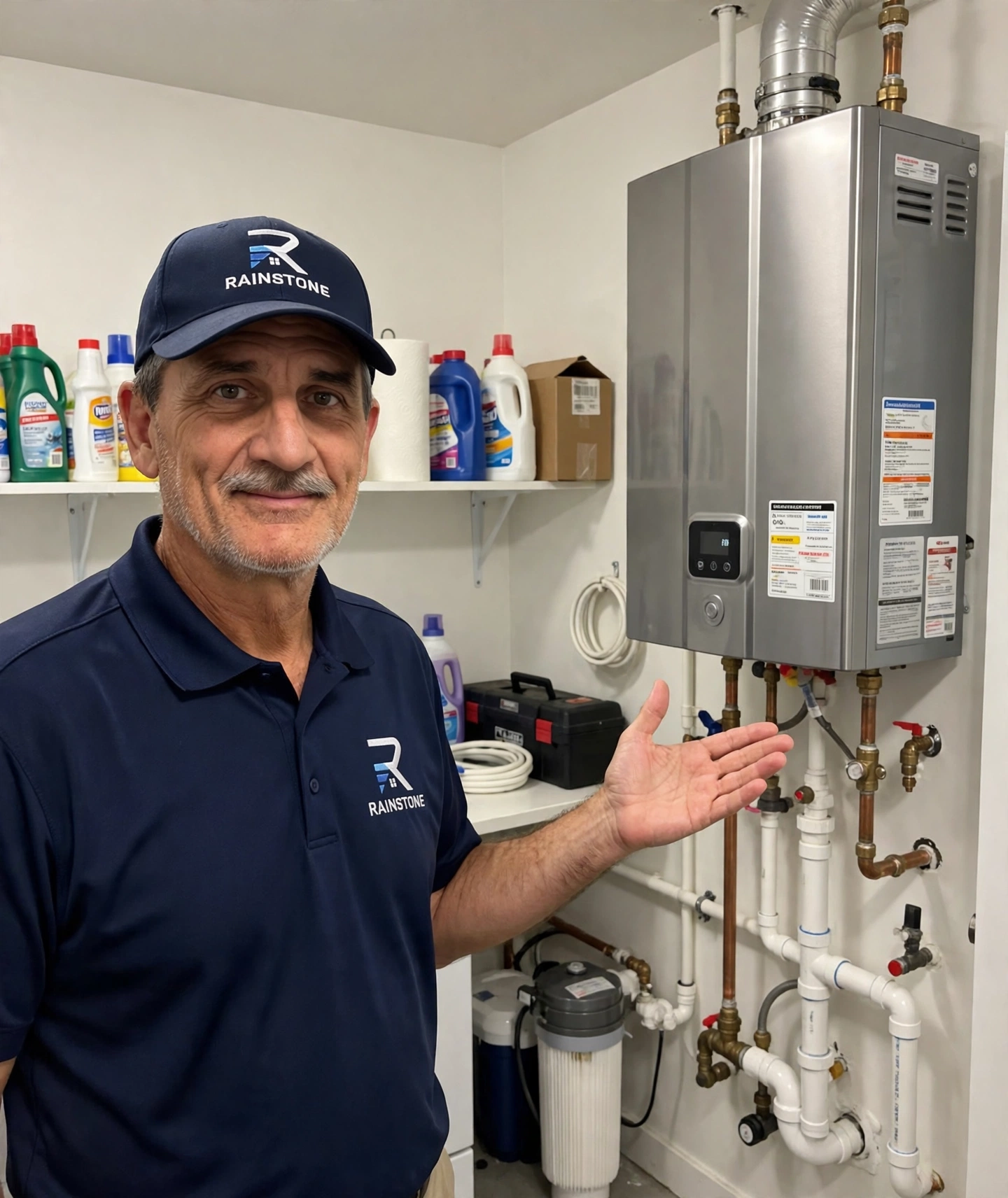
Water finds the path you cannot see, and by the time a water heater leak shows itself, it has usually been traveling for a while. I am Kurt Pinkerton, Rainstone’s responsible master plumber — leak work is detective work, and we treat it that way. Here in Round Rock, my team works out of our Round Rock office, and the standard is the one I set: a $125 service call, a written quote before work begins, and no surprises on the invoice. Call us at 512-881-9603.
How Water Heater Leaks Behave in Round Rock’s Slab Foundation Homes
Kurt’s take: Thirty-eight years in this trade — 27 of them carrying a master plumber’s license — teaches a man to read a water heater closet the way other men read a weather report. Water goes where it wants, and the stain on the ceiling is rarely under the source. Tracing a leak is patient work — fittings, valves, the tank body itself — and anyone who pronounces a verdict from the doorway is guessing with your drywall. The LCRA surface water feeding this area carries a limestone load that settles and scales on its own schedule, indifferent to what the equipment manual hoped for. My rule for the crew is the one I was taught: give the homeowner the honest repair-versus-replace math, even when the honest answer is the smaller ticket.
The Slab Foundation Context: How Leaks Travel Differently in Round Rock’s Most Common Home Type
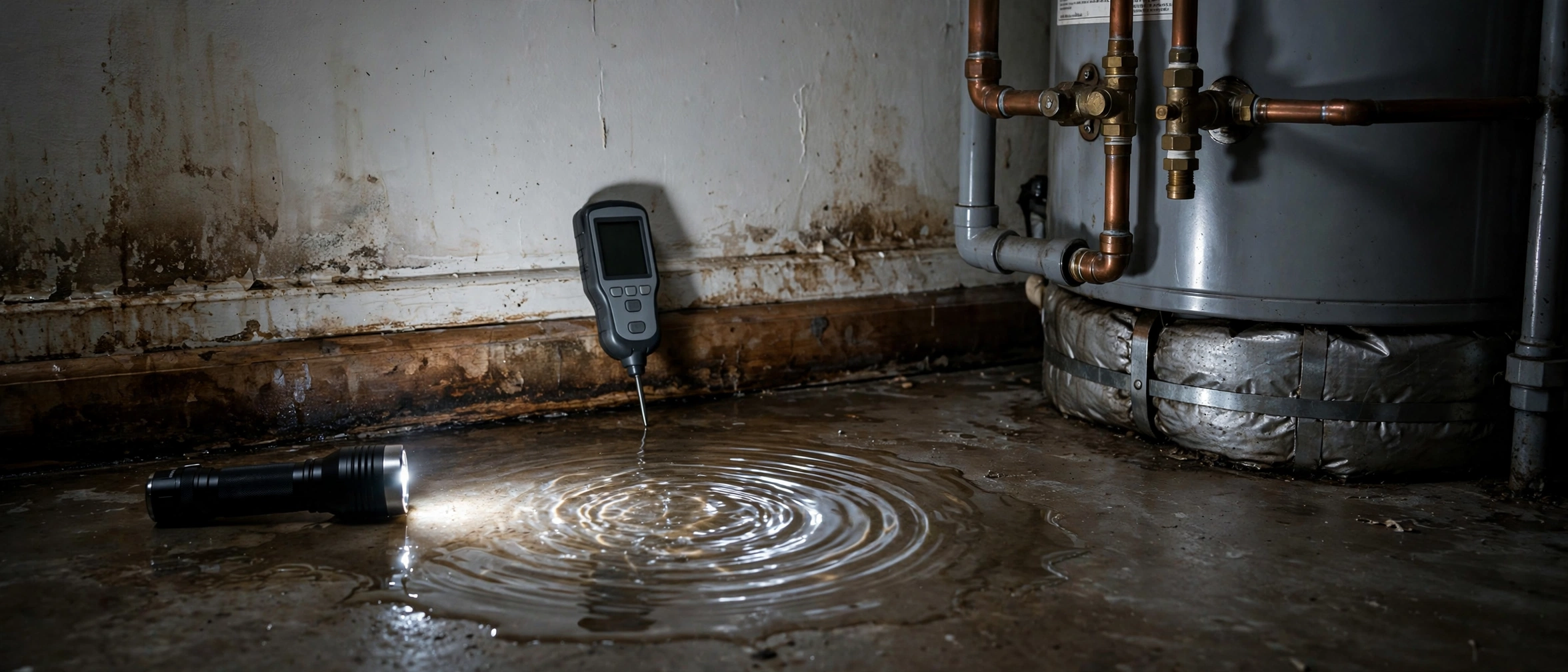
The vast majority of Round Rock’s residential properties sit on concrete slab foundations rather than raised crawl space or basement foundations, a construction characteristic that shapes how water heater leaks behave and accumulate in fundamental ways. In a home with a crawl space or basement, a slow leak from a water heater fitting typically drips into a sub-floor cavity where it is absorbed by framing, insulation, and floor sheathing over time — a slow accumulation process that can produce significant structural and mold damage before it becomes visible at the finished floor level above. In a slab-foundation home, the same leak drips directly onto a concrete surface and remains visible in principle, but the specific configuration of a garage-installed water heater means that the water may drain toward a floor drain or toward the garage door threshold before the homeowner has occasion to be in the right position to see it.
The concrete slab itself is not impervious to sustained water exposure. A slow water heater leak that pools repeatedly in the same area of the garage floor over months or years can infiltrate the slab through existing cracks or construction joints, creating a pathway for moisture to reach the subgrade below. In Central Texas, where expansive clay soils underlie many of Round Rock’s suburban subdivisions, this moisture introduction into the subgrade can cause localized soil movement that affects slab stability — a consequence of a water heater leak that most homeowners would not intuitively connect to their hot water system but that the construction geology of Williamson County makes a realistic concern for properties experiencing long-term unresolved water heater leaks near slab penetrations or expansion joints.
Water Damage Pathways From Garage-Installed Water Heaters to Living Areas
In Round Rock’s attached garage homes — the predominant configuration across the city’s suburban neighborhoods — the garage shares a wall with the living area, and the floor levels of the garage and the adjacent living space are typically separated by a step up at the doorway threshold. A slow leak from a garage-installed water heater that produces water flow across the garage floor can reach this threshold through the natural gradient of the garage slab, and once water reaches the doorway seal, it can infiltrate under the interior flooring on the other side. In homes with engineered wood or laminate flooring in the adjacent living area, even a small and intermittent water infiltration at this point can cause the flooring material to swell, delaminate, and require replacement over a relatively short period of exposure.
Our leak detection approach in Round Rock’s attached garage properties includes a specific assessment of the garage floor for moisture patterns or staining that indicate water has been tracking from the water heater location toward the doorway threshold, as well as a check of the flooring condition immediately inside the connecting doorway for any signs of moisture infiltration, swelling, or edge separation that would indicate water has been reaching the interior from the garage side. This cross-threshold assessment is a component of leak detection that is specific to the attached garage configuration that dominates Round Rock’s housing stock and that adds a dimension to the assessment that a standard fitting-and-valve-focused leak check would not cover.
Identifying a Slow Leak Before It Becomes a Slab or Foundation Issue
The most reliable early indicator of a slow water heater leak in a Round Rock slab-foundation home is a recurring moisture pattern on the garage floor near the base of the unit that reappears after being cleaned or dried. A single damp spot that could be attributed to condensation or a tracked-in rain event is not diagnostic, but a pattern that reforms consistently within a day or two of being cleaned, or that produces a persistent mineral or salt staining ring on the concrete as the pooled water evaporates repeatedly in the same location, is a reliable indicator of an ongoing slow leak rather than a one-time moisture event. Round Rock homeowners who notice this pattern should contact a professional leak detection service rather than allowing the situation to continue, since the damage that accumulates from a slow leak over months of inaction typically exceeds the cost of the repair that would have resolved it at the point of first detection.
Water Heater Leak Risk Across Round Rock’s Diverse Property Age and Condition Spectrum
Kurt’s take: I have trained more than 25 people from their first day holding a wrench all the way to journeyman, and several of them run plumbing companies of their own today. Never let anyone sell you a water heater for a leak they have not traced. I have seen sound tanks condemned for a failed fitting that cost less than the service call, and I have made our crew show the homeowner the actual source before we quote the actual fix. Our Round Rock crews run 5 AM to 11 PM, seven days a week, because a family’s hot water does not keep office hours and neither do we. That is why every job I sign for starts with a written quote before work begins — no surprises after the fact. — Kurt Pinkerton, Responsible Master Plumber, Lic. # M-21546
Leak Detection in Round Rock’s Aging Homes: Pre-Purchase and Post-Purchase Scenarios
Round Rock’s sustained property market activity has produced two distinct leak detection scenarios that our team encounters regularly across the city. The first involves homeowners who are purchasing a Round Rock property and want a pre-purchase water heater assessment that goes beyond the general home inspection, specifically to determine whether the water heater has any active or developing leak conditions that the general inspector may not have identified in the course of a broader property assessment. Our pre-purchase leak assessment for Round Rock buyers includes a specific examination of the installation area for historical moisture evidence — mineral staining on the floor, efflorescence on the concrete, or rust staining on the unit’s base stand — that would indicate a previous or ongoing leak that has not been disclosed as part of the sale.
The second scenario involves Round Rock homeowners who purchased an existing property within the past one to three years and are now noticing signs of a water heater leak that may have been present but concealed at the time of purchase. Round Rock Water Utilities tracks monthly water consumption for all residential accounts, and homeowners who compare their actual LCRA water usage data across consecutive billing periods and find an unexplained upward trend have a useful early indicator that a slow leak may be present somewhere in the property’s plumbing, including the water heater. Our team uses this consumption data alongside physical inspection findings to build a complete picture of whether a water heater leak is contributing to the consumption pattern, and to identify its specific source when one is confirmed.
New Construction Warranty Leaks in Round Rock’s Active Builder Market
In Williamson County, where new residential construction is active across multiple simultaneous subdivision projects, water heater leaks in newly occupied properties occur more frequently than most buyers expect and deserve specific attention. A new water heater installed in a new Round Rock home may develop a leak at a connection fitting within the first year of occupancy due to improper thread sealant application, insufficient torque on a threaded joint during the installation rush of a high-volume builder operation, or construction debris in the new plumbing system that has caused early abrasion or damage to internal valve components. These early-life leaks typically fall within the builder’s or manufacturer’s warranty period but must be identified and reported promptly to qualify for warranty coverage rather than being allowed to continue until the warranty period has expired.
Our leak detection service for Round Rock new-build homeowners includes a specific assessment of the plumbing installation quality around the water heater, confirming that connections are correctly sealed, that the pressure relief valve discharge pipe is properly routed, and that there is no evidence of installation-phase debris damage to any component in the water heating circuit. Where a warranty-qualifying fault is identified, we provide the documentation and diagnosis that the homeowner needs to present to the builder for warranty remediation, giving them the professional evidence required to support a warranty claim rather than a subjective report that may not be accepted as grounds for a builder response.
How LCRA Water Usage Data Can Signal an Undetected Water Heater Leak
Round Rock homeowners who monitor their monthly LCRA water consumption through the City of Round Rock Water Utilities’ online account portal have access to a practical early leak detection tool that requires no technical knowledge to use. A month-over-month increase in consumption that cannot be explained by a known change in household usage — additional occupants, a new irrigation cycle, a pool fill — is a standard indicator that water is being lost somewhere in the property’s plumbing without the homeowner’s awareness. Water heater connections and fittings are among the most common sources of this type of undetected slow loss, and a consumption-driven suspicion of a household leak is a sound trigger for a professional water heater leak detection assessment, even in the absence of any visible moisture in the installation area. Our team incorporates this data into the diagnostic process wherever the homeowner can share it, using the measured consumption trend as a corroborating indicator alongside the physical inspection findings to confirm or rule out the water heater as a contributing source.
Contact Rainstone Water Heaters for Leak Detection in Round Rock Today
If you suspect your Round Rock water heater may be leaking — whether you have noticed a moisture pattern on the garage floor, a rise in your LCRA water bill, or simply want a professional assessment before or after a property purchase — the team at Rainstone Water Heaters is equipped to provide the thorough, slab-foundation-aware leak detection service that Round Rock’s specific construction context demands. From the established neighborhoods of the city’s core to the newest builds in Williamson County’s active construction zones, we trace water heater leaks accurately and provide actionable findings that protect your property and your household’s hot water supply. Call us today at (512) 881-9603 to book a service and get a definitive answer on your Round Rock water heater’s condition.
Leak Detection in Round Rock: the numbers we work by
| Where the water is | What it usually means |
|---|---|
| Pooled under the tank | Tank corrosion or a failed fitting — the unit must be inspected before anyone calls it minor |
| Dripping from the T&P discharge pipe | Pressure or temperature problem — the valve is doing its job and reporting a fault |
| Wet at the top connections | Inlet/outlet fitting or flex-line failure — often repairable if the tank is sound |
| Damp drywall or flooring nearby, unit dry | The leak may be in the line, not the heater — which is why we trace before we quote |
| Detection visit | $125 service call — source identified and written quote for the repair |
How we handle it, step by step
- We start with the water’s story — when it appears, how much, and what changed in the house around the same time.
- We inspect the unit and its connections under pressure, then trace outward along the lines the water could be traveling.
- We separate the source from the symptom. A wet floor is a symptom; the failed fitting two feet away is the source.
- You get the finding and the fix in writing — repair the fitting, or, if the tank itself is weeping, an honest replacement conversation.
For an independent cross-check on the numbers above: the U.S. Department of Energy’s homeowner guidance puts a conventional storage water heater’s service life at roughly 10–15 years and recommends a thermostat setting of 120°F. The lifespan and price figures in our table are the ones Rainstone publishes in its own Texas cost guides — and the ones we stand behind on every written quote.
More water heater services in Round Rock
- Water Heater Repairs in Round Rock
- Water Heater Replacement in Round Rock
- Water Heater Installation in Round Rock
- Tankless Water Heaters in Round Rock
- Water Heater Maintenance in Round Rock
- Water Heater Inspections in Round Rock
- Emergency Water Heater Repairs in Round Rock
- Commercial Water Heaters in Round Rock
We keep local homes in hot water all year — take a look at our Round Rock water heater services for the complete list.