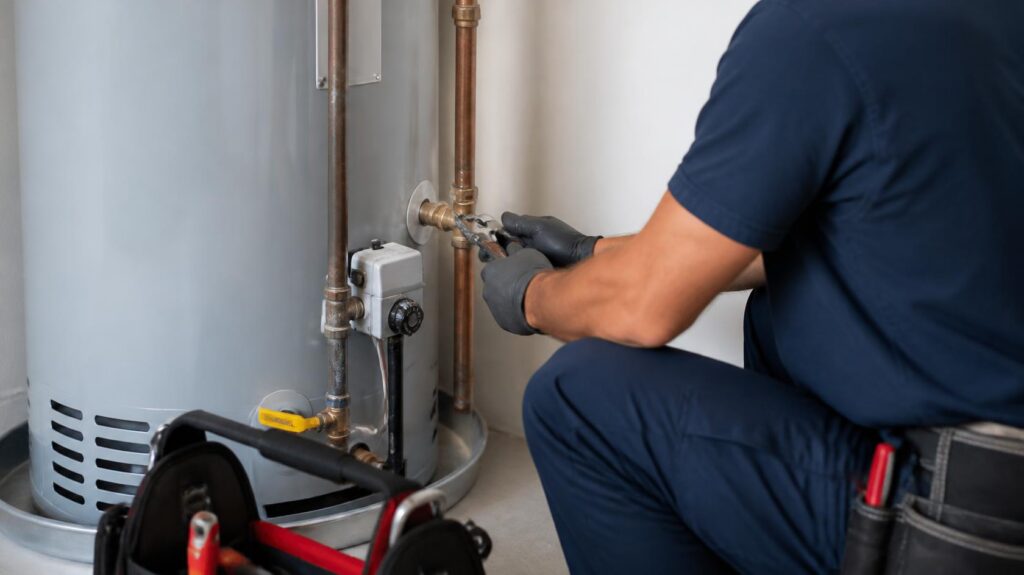
Water heater repairs in Round Rock are increasingly shaped by the age of the city’s first-generation suburban housing stock. The wave of homes built between 1995 and 2010 in neighborhoods across Williamson County is now old enough that original water heaters are developing faults at a growing rate, and many of these units have accumulated twenty or more years of wear without a single professional service visit. At the same time, Round Rock’s continued growth means that a significant proportion of homeowners have purchased properties recently and have no knowledge of the water heater’s service history before they moved in. At Rainstone Water Heaters, we diagnose and repair water heaters across Round Rock with the specific understanding of how the city’s housing age, LCRA surface water conditions, and Austin-area climate combine to drive the fault patterns we see most frequently in the city’s homes. Call us at (512) 881-9603 to book a service today.
When a water heater fails, the first job is not turning a wrench — it is finding the real fault. I am Kurt Pinkerton, Rainstone’s responsible master plumber, and I have built our repair work around one rule: we diagnose first, quote in writing, and only then repair. Here in Round Rock, my team works out of our Round Rock office, and the standard is the one I set: a $125 service call, a written quote before work begins, and no surprises on the invoice. Call us at 512-881-9603.
Repair Patterns Specific to Round Rock’s Aging Suburban Home Stock
Kurt’s take: I am a grandfather, and I am bringing my own grandkids into this trade — so I think about the family on the other side of a water heater a little differently than a man who is just selling a job. A repair call is won or lost in the diagnosis, before a single part comes off the truck. Thermostats, elements, gas valves, and anode rods all fail with similar symptoms, and the shop that guesses parts at a heater will guess its way through your money too. The LCRA surface water feeding this area carries a limestone load that settles and scales on its own schedule, indifferent to what the equipment manual hoped for. My rule for the crew is the one I was taught: give the homeowner the honest repair-versus-replace math, even when the honest answer is the smaller ticket.
Thermostat and Control Board Failures After Two Decades of Continuous Operation
After twenty or more years of continuous heating cycles, the thermostat and control components of both gas and electric water heaters in Round Rock’s older homes are reaching the natural end of their operational lifespan. Gas water heater thermostats, integrated into the gas control valve assembly, are subject to the accumulated effects of mineral contact through the thermostat sensing probe, thermal fatigue from repeated heating cycles, and the gradual deterioration of control valve internal components that sets in as the unit enters its second decade of service. The presenting symptom is typically a unit that fails to maintain its set temperature reliably — either consistently producing cooler water than the thermostat indicates, or one that cycles on and off more frequently or less frequently than normal, indicating a sensing component that no longer reads temperature accurately.
In Round Rock’s established neighborhoods — including Forest Creek, Teravista, the Old Settlers Park area, and Chandler Creek, where many homes were completed between 1995 and 2005 — thermostat and gas valve control failures are among the most common repair calls our technicians receive. These neighborhoods are now reaching the twenty-year threshold at which the original water heater’s control components are statistically approaching their end-of-service condition, and the replacement of these components in an otherwise structurally sound unit is a repair that can be cost-effective if the tank itself is in good internal condition. Our technicians assess the overall unit condition at the time of every control component repair visit, giving homeowners the complete picture needed to decide whether the repair is a sound investment in the unit’s remaining life or whether the control failure is occurring alongside other indicators that make replacement the better financial path.
Dip Tube Deterioration: A Recognized Issue in Late-1990s Water Heater Installations
A specific repair scenario that our technicians encounter regularly in Round Rock’s late-1990s homes is dip tube failure resulting from the manufacturing defect that affected plastic dip tubes produced during a period in the mid-1990s. During this period, a significant number of water heater manufacturers used a polypropylene dip tube composition that proved susceptible to accelerated brittleness and breakage over time, causing fragments to enter the household plumbing and lodge in aerators and showerheads throughout the property while also allowing cold inlet water to mix directly with the hot stored water rather than being directed to the tank base where it should be heated. The symptom — consistently lukewarm water despite the thermostat being set correctly, combined with reduced flow at certain fixtures — is distinctive enough that our technicians recognize it quickly, but it is also frequently misdiagnosed by homeowners as a thermostat fault.
Round Rock’s housing stock is disproportionately concentrated in the late-1990s and early-2000s build period precisely because the city’s most intense growth phase began around this time, meaning that the demographic of homes most affected by this dip tube issue is overrepresented in Round Rock relative to cities with a more evenly distributed building age profile. When our technicians find a dip tube failure in a Round Rock unit of this vintage, replacement of the tube is paired with a recommendation to flush the downstream plumbing system and clean the aerators at each fixture, since plastic fragments already in the supply lines will continue to create flow restrictions at fixtures until they are cleared. This whole-system approach to the repair prevents the frustrating outcome of replacing the dip tube and then receiving continued complaints about reduced flow at fixtures from particles that remained in the lines after the repair was completed.
Drain Valve Failure and Mineral-Related Blockages in Long-Running Round Rock Units
The drain valve at the base of a water heater tank is a component that receives no attention in most Round Rock homes until it either fails by leaking or becomes unusable due to mineral encrustation. In a unit that has been operating for fifteen to twenty-five years without being flushed, the drain valve may be so heavily coated with mineral deposits and so long unused that it cannot be turned at all, meaning that any attempt to flush the tank will require removing the valve entirely before the flush can proceed. This scenario, which our team encounters regularly in Round Rock’s older homes, requires the water supply to be shut off, the pressure in the system to be relieved before the removal attempt, and the valve to be replaced with a brass ball-style fitting that provides significantly more reliable long-term function than the plastic valve bodies that are standard on most production water heaters.
In cases where the drain valve has been leaking for an undetected period — which can occur when the valve seat deteriorates from extended non-use and the slow drip is absorbed by the concrete slab or garage floor before becoming visually obvious — the area beneath the unit may show signs of chronic moisture exposure that extend beyond the repair of the valve itself. The Williamson County and Cities Health District, which monitors environmental and property health conditions across the Round Rock area, notes that persistent moisture in residential spaces can create conditions favorable to mold growth and structural material deterioration, making prompt identification and resolution of even a minor drain valve leak an important step for protecting the broader condition of the installation area.
Anode Depletion Leading to Internal Corrosion in Never-Inspected Round Rock Units
In Round Rock homes where the original water heater has operated for two decades or more without an anode rod inspection or replacement, the most significant repair consequence is typically not a single component failure but a pattern of generalized internal deterioration that results from years of unprotected corrosive contact between the tank steel and the LCRA water supply. Once the anode rod has been fully depleted, the corrosion process that it was designed to intercept transfers to the tank interior, and in the slower accumulation environment of Round Rock’s moderately hard LCRA water, this corrosion progresses at a rate that is less dramatic than in harder-water cities but still produces meaningful structural deterioration over the years between complete anode depletion and the point at which the homeowner notices a visible symptom such as rust-tinted water.
By the time rust-tinted hot water is appearing at the tap in a Round Rock home, the internal tank corrosion is already well advanced, and the practical question our technicians must answer at that repair visit is not whether to replace the anode rod but whether the tank has deteriorated to the point where repair is a reasonable investment. In many cases in Round Rock’s older housing stock, the finding is that the tank has passed the threshold beyond which repair is sound, and the repair call becomes the occasion for a replacement conversation. Our team manages this transition transparently, giving homeowners a clear explanation of what the rust-tinted water indicates, what a replacement would involve, and the timeline within which the decision should be made to avoid the risk of a more sudden and disruptive failure.
Expansion Tank Membrane Failure and Its Effect on Water Heater Components
Expansion tanks installed in Round Rock homes at the time of original water heater installation have a typical effective membrane life of eight to twelve years, meaning that the expansion tanks in Round Rock’s late-1990s and early-2000s homes have been overdue for replacement for a decade or more if they were fitted at original installation and have not been subsequently inspected or replaced. A waterlogged expansion tank — one in which the internal bladder has failed, and the tank is completely filled with water with no air charge remaining — provides no pressure absorption at all, and the full thermal expansion pressure from each heating cycle falls directly on the TPR valve, the tank connections, and the plumbing joints throughout the closed system. The repair consequence is a pattern of pressure-related faults: TPR valves that weep continuously, connection fittings at the tank top that loosen or leak, and in advanced cases, premature failure of other pressure-sensitive components throughout the property’s plumbing.
Identifying expansion tank membrane failure is a standard part of every repair visit our team makes to a Round Rock home, because the pressure-related faults that a failed expansion tank causes will recur on any new component fitted to the system until the expansion tank is replaced. Replacing the connection fitting that is leaking without also replacing the failed expansion tank that is causing the pressure stress results in a repaired fitting that begins to fail again at an accelerated rate, and the homeowner experiences what feels like a recurrent fault when the actual problem is a failed accessory component that has not been addressed. Our technicians trace the full causal chain on every pressure-related repair call and resolve the underlying pressure condition as part of the same visit where the visible fault is repaired.
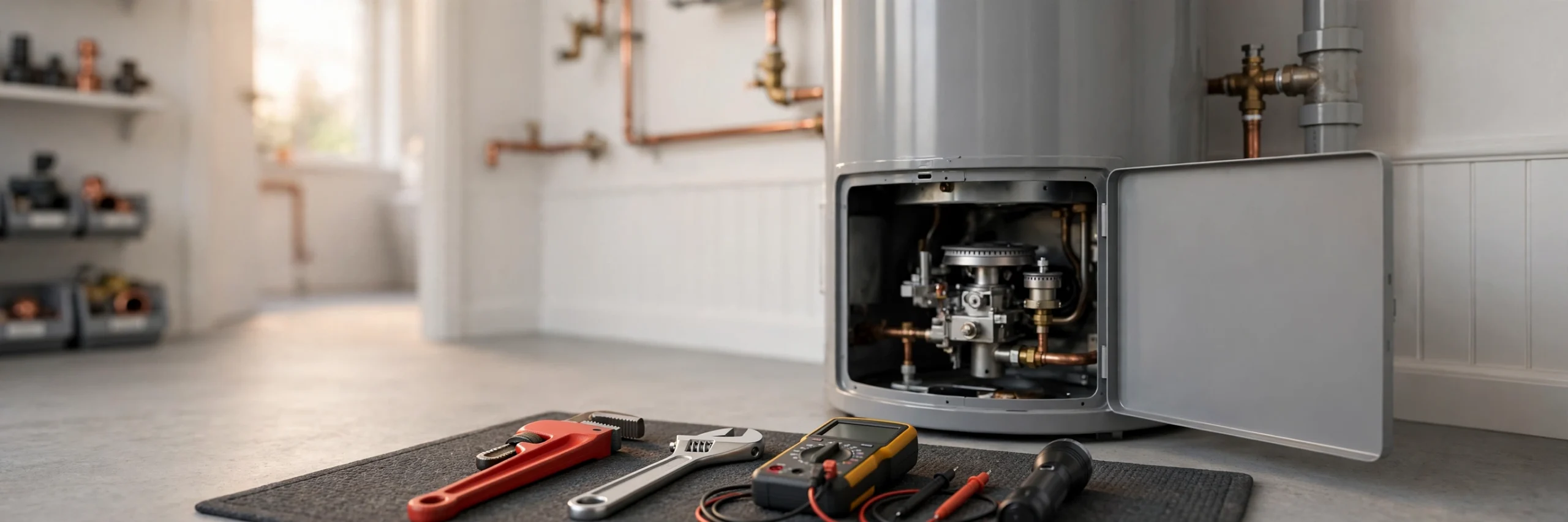
How LCRA Surface Water Conditions Shape Repair Timelines in Round Rock
Kurt’s take: Here is what 38 years teaches a man: the expensive failures almost always start as cheap ones somebody decided to ignore. Before booking a repair, a homeowner deserves to know the unit’s age and the honest math: what this fix costs, what it buys in years, and when the same money belongs in a replacement instead. I would rather lose a repair ticket to that honesty than win one without it. Our Round Rock crews run 5 AM to 11 PM, seven days a week, because a family’s hot water does not keep office hours and neither do we. That is why every job I sign for starts with a written quote before work begins — no surprises after the fact. — Kurt Pinkerton, Responsible Master Plumber, Lic. # M-21546
The Moderate Hardness Profile of LCRA Water and the Repair Frequency It Drives
Round Rock’s LCRA surface water supply is typically classified as moderately hard, a characterization that places it between the aggressively hard groundwater supplied to cities such as San Antonio and Waco and the genuinely soft water available in regions supplied by high-rainfall surface sources with minimal limestone contact. For water heater repair purposes, moderate hardness means that the mineral-driven damage mechanisms — scale on heating elements, anode depletion, sediment accumulation, and fitting corrosion — are active and producing wear in Round Rock units but at a pace that is meaningfully slower than in harder-water cities. The practical consequence is that Round Rock water heaters have longer windows between maintenance interventions than similar units in San Antonio, but shorter windows than units in soft-water supply areas, and repair needs that are strongly correlated with maintenance gaps rather than with unavoidable component lifespans.
According to the Texas State Board of Plumbing Examiners, water heater service and repair work in Texas must be carried out by licensed plumbers or their supervised apprentices, a requirement that exists because water heater faults — particularly those involving gas connections, pressure components, and flue venting — carry safety implications that amateur repair attempts can significantly worsen. The licensing requirement is particularly relevant in Round Rock, where the city’s rapid growth has attracted a large number of handyman service providers whose online profiles may not make the distinction between general home repair work and the licensed plumbing activity that water heater repair represents. Our team meets the licensing requirements for every type of water heater repair we carry out across Round Rock and throughout the broader Williamson County area.
Austin-Area Summer Heat and Its Role in Accelerating Repair-Triggering Wear
The Austin-Round Rock metropolitan area regularly records summer temperatures above one hundred degrees Fahrenheit, and during peak summer months, garage-installed water heaters in Round Rock are operating in ambient temperatures that can exceed one hundred and ten degrees Fahrenheit or higher inside an unventilated garage space. This elevated ambient temperature affects the water heater in several ways that accelerate wear and increase the likelihood of repair-triggering faults developing during the summer months. The thermostat, which senses the surrounding temperature as part of its calibration environment, may read the elevated ambient heat as contributing to water temperature, causing the unit to run shorter cycles than it should and producing water that does not reach the set temperature consistently during the hottest weeks of the year.
The insulation blanket around the tank, which is designed to maintain the water temperature between heating cycles, is less effective in an ambient environment that is itself close to the tank’s target temperature, resulting in reduced standby efficiency and more frequent heating cycles than would occur in a climate-controlled installation environment. Over an extended series of summers, the accumulated effect of this thermal stress — more frequent cycling, elevated operating temperatures, and higher current draw in electric units — accelerates the wear rate of heating elements, thermostats, and control components in ways that show up as repair needs during or shortly after the summer peak, which is the most common timing for repair calls we receive from Round Rock homeowners during the late summer and early autumn months.
Inherited Maintenance Debt: Repair Calls From Round Rock’s Changing Homeowner Population
Williamson County experienced some of the highest rates of residential property turnover in Texas during the post-pandemic real estate market activity of 2020 to 2022, creating a large cohort of relatively recent homeowners across Round Rock who may have little or no information about the service history of their property’s water heater. When a homeowner purchases a Round Rock property with an original late-1990s water heater that has never been serviced, they inherit not just the unit but all of the deferred maintenance that accumulated under the previous occupant. The repair calls that result from this inherited maintenance debt often arrive within the first two to three years of the new homeowner’s occupancy, as the accumulated wear reaches a tipping point that produces a visible symptom — discolored water, inconsistent temperature, a dripping fitting — that prompts a service call.
Round Rock’s rapid growth has also brought a large and diverse homeowner population to Williamson County, including many families relocating from other states who may be encountering LCRA surface water conditions for the first time and who do not have an established relationship with a local water heater service provider. For these homeowners, the first repair call is often also the occasion of a first professional assessment of the unit’s overall condition, and it is an opportunity for our team to provide not just the immediate repair but also the context and maintenance routine that prevents the next fault from developing before its time. Our approach to every Round Rock repair call includes this broader orientation alongside the specific repair work, giving newly arrived Williamson County homeowners the local knowledge base they need to manage their water heating system effectively from the point of their first contact with us.
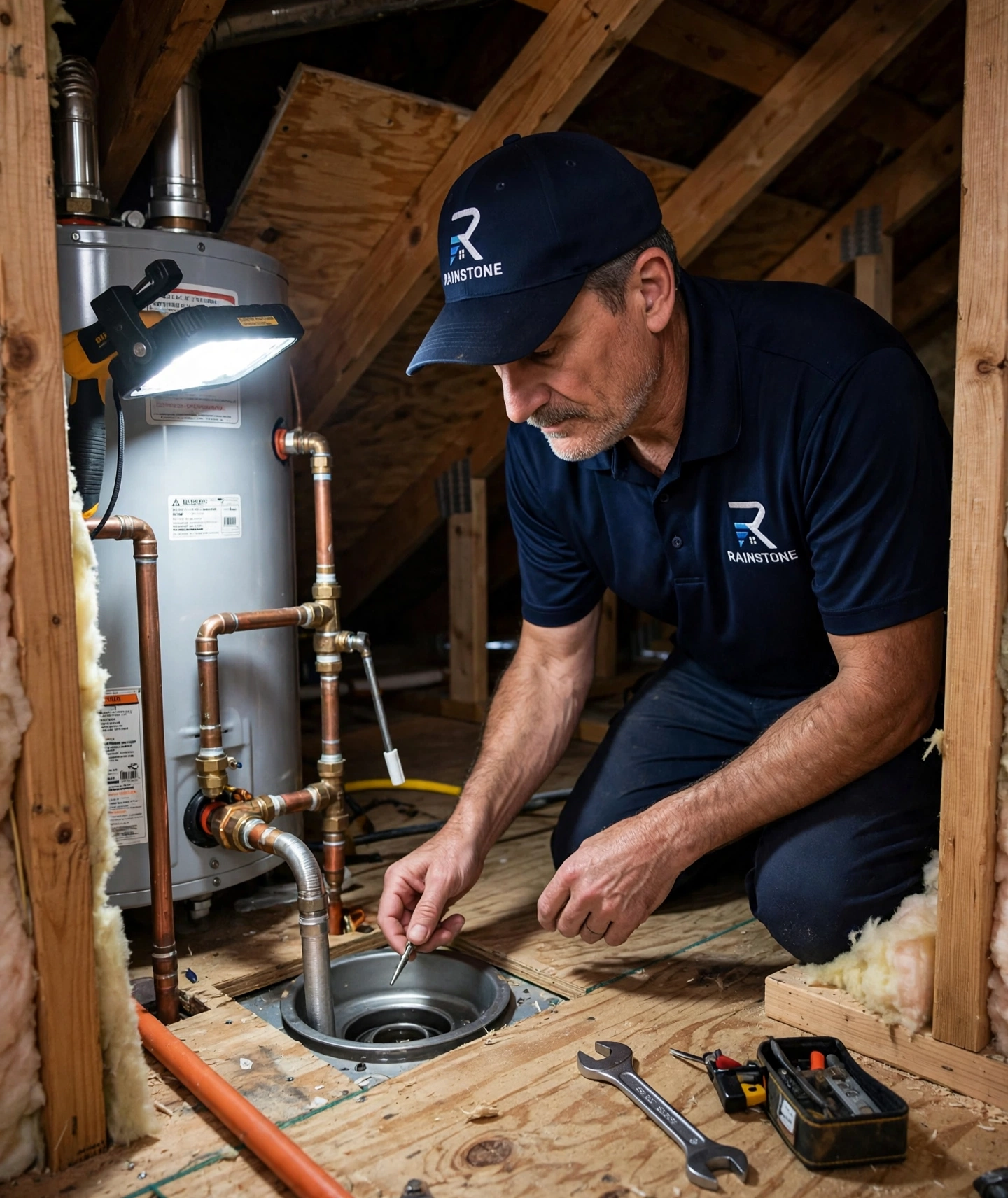
What Round Rock Homeowners Should Know Before Booking a Repair
Diagnosing Root Cause Rather Than Treating Visible Symptoms
The most effective water heater repairs address the underlying cause of the fault rather than just the component that has produced the visible symptom. In Round Rock’s older homes, a visible symptom such as a leaking fitting or a struggling thermostat is frequently not an isolated fault but the most visible expression of a broader pattern of deterioration driven by accumulated scale, anode depletion, or pressure stress from a failed expansion tank. Replacing the leaking fitting without identifying and resolving its underlying cause results in a repair that is technically complete at the time of the visit, but that recurs within a shorter time frame than the homeowner expects. Our technicians are trained to look beyond the presenting fault to the systemic conditions that produced it, and to communicate these findings to the homeowner so that the repair decision is made with a full understanding of what is being resolved and what will require attention next.
For Round Rock homeowners whose water heater is in the fifteen-to-twenty-five-year age range and has not previously been serviced, a repair visit from Rainstone Water Heaters includes a comprehensive assessment of the unit’s overall condition alongside the specific diagnostic work related to the presenting fault. The findings from this broader assessment give the homeowner a complete picture of what is wrong with the unit, what else is likely to require attention in the near future, and whether the proposed repair represents a sound investment in a unit with meaningful remaining service life or whether the repair and the condition together constitute an argument for replacement planning. This transparency is our standard approach on every repair call in Round Rock, regardless of the age or type of the unit involved.
When a Repair Quote Should Prompt a Replacement Conversation in a Round Rock Home
In a city where a large proportion of the housing stock is now carrying original water heaters at or beyond their expected service life, the repair-versus-replace question arises regularly in Round Rock service calls. The financial threshold that generally makes replacement the better choice — when the repair cost exceeds fifty percent of the installed cost of a new unit and the existing unit is more than halfway through its expected service life — is frequently met by the repair scenarios we see in Round Rock’s aging first-generation suburban homes. A gas valve replacement on a twelve-year-old unit in otherwise reasonable condition is a defensible repair. The same repair on a twenty-two-year-old unit with a seized drain valve, a depleted anode, and a pressure-stressed TPR fitting is a very different financial calculation, and our technicians will tell you so directly rather than proceeding with a repair that does not serve the homeowner’s best interests.
When the assessment points toward replacement, our team provides the homeowner with a clear explanation of the findings, a realistic assessment of the remaining service life that the unit is likely to offer even with the repair completed, and guidance on what a replacement would involve in terms of cost, timing, and the unit options that are best suited to their Round Rock home and household. This conversation is best had as a planned discussion rather than in the middle of an emergency failure, and homeowners who book a diagnostic visit with Rainstone Water Heaters when they notice the first signs of deterioration are far better positioned to make a calm, informed decision than those who wait until the unit fails completely. Call us today at (512) 881-9603 to book your Round Rock repair service.
Book Your Water Heater Repair in Round Rock With Rainstone Water Heaters Today
Water heater faults in Round Rock’s aging suburban homes and newer properties alike need the kind of professional, root-cause-focused repair approach that protects the homeowner from repeat service calls and misallocated repair spending. At Rainstone Water Heaters, we bring specific knowledge of the fault patterns, water supply conditions, and housing stock characteristics that define Round Rock’s water heater repair landscape, and we bring this context to every service call we make across Williamson County. From established neighborhoods in the heart of Round Rock to newer communities on the city’s growing edges, we deliver the same thorough, honest, and effectively executed repair work on every visit. Call us today at (512) 881-9603 to book your service and get your Round Rock water heater back in reliable working order.
Water Heater Repairs in Round Rock: the numbers we work by
| Common repair | What you pay | How we handle it |
|---|---|---|
| Diagnosis / service call | $125 | We find the fault and give you a written quote before any repair begins |
| Gas control valve replacement | $615 | One of the most common gas-unit repairs we make — priced flat, not by the hour |
| Heating elements, thermostats, anode rods, T&P valves | Quoted in writing after diagnosis | The $125 service call comes first, so the quote is based on your unit, not a guess over the phone |
How we handle it, step by step
- You call, we come out for a $125 service call. A licensed technician tests the unit — thermostats, elements, gas valve, venting, and the tank itself.
- You get the quote in writing. If a part fixes it, the quote says so. If the tank is gone, we say that instead, and show you why.
- We repair only what you approved. No add-ons appear on the invoice that were not on the quote.
- We test under load before we leave. Hot water at the tap, no leaks at the fittings, and the work area left clean.
For an independent cross-check on the numbers above: the U.S. Department of Energy’s homeowner guidance puts a conventional storage water heater’s service life at roughly 10–15 years and recommends a thermostat setting of 120°F. The lifespan and price figures in our table are the ones Rainstone publishes in its own Texas cost guides — and the ones we stand behind on every written quote.
More water heater services in Round Rock
- Water Heater Replacement in Round Rock
- Water Heater Installation in Round Rock
- Tankless Water Heaters in Round Rock
- Water Heater Maintenance in Round Rock
- Water Heater Inspections in Round Rock
- Emergency Water Heater Repairs in Round Rock
- Leak Detection in Round Rock
- Commercial Water Heaters in Round Rock
We keep local homes in hot water all year — take a look at our Round Rock water heater services for the complete list.