
Pflugerville grew out of German farm country — Henry Pfluger Sr. and his family put down roots here in 1849 — and it still carries that plain-spoken, build-it-to-last character even as it has become one of the northern Austin metro’s large suburban cities, with a population of 65,191 at the 2020 census. The housing tells the story in layers: an older core around the East Main Street Historic District, big 1990s and 2000s subdivisions like Blackhawk and Falcon Pointe spreading east, and newer construction still filling in along the SH-130 and SH-45 toll corridors. Each layer asks something different of a water heater, and the homes built in the subdivision boom are now squarely in the age range where original tanks reach the end of their working lives. At Rainstone Water Heaters, we serve Pflugerville from our Round Rock office, just up the road. Call us today at (512) 881-9603 to book a service with your Pflugerville water heater company.
Pflugerville’s Farm-Town Roots and Subdivision Growth: Two Generations of Water Heaters
Kurt’s take: Thirty-eight years in this trade — 27 of them carrying a master plumber’s license — teaches a man to read a water heater closet the way other men read a weather report. Pflugerville has farm-town bones and subdivision growth layered right on top of each other, so two houses on the same street can be two generations of water heater apart. I tell our crew: date the house before you judge the heater, because the right advice for a 1990s tank is wrong for a 2018 one. It is also why our $125 service call is waived in full when you go ahead with any replacement — a diagnosis should never feel like a trap.
The Historic Core and the Older Streets Around Downtown
Pflugerville’s oldest homes sit near the downtown streets that grew up around the cotton gin and the railroad, in and around the East Main Street Historic District. Houses here date from the early and mid twentieth century through the 1970s and 1980s, and their water heaters live the harder version of the appliance’s life: tight utility closets and garage corners that were not sized for modern tank dimensions, older supply piping at the connection points, and venting runs that reflect the building practice of their decade rather than today’s code.
Servicing these homes well means assessing the whole installation before recommending anything — measuring the space, reading the venting, and checking the connections — because a replacement that ignores the constraints of an older Pflugerville house creates the next problem while solving the current one. Our technicians work in these older properties regularly and communicate what they find in plain terms, so the homeowner understands both the immediate repair and the condition of everything around it.
Blackhawk, Falcon Pointe, and the 2000s Subdivision Belt
East of downtown, Pflugerville’s character changes to the master-planned subdivisions that carried its growth through the 1990s and 2000s — Blackhawk, Falcon Pointe, Springbrook, and their neighbors along FM 1825 and the toll-road corridors. These are family homes, most of them two-story, many with the water heater in an attic or an upstairs closet as Texas builders of that era commonly placed them. That placement matters: when a tank in an attic fails, the water does not stay in the garage — it comes through a ceiling.
Most of these homes are now on their second water heater, and a good number are approaching the decision about their third. The honest questions are the same ones we ask everywhere — how old is the unit, how hard has the water been on it, and does a repair buy real years or just postpone a failure into a worse week? We answer them with the tank in front of us, quote the work in writing, and let the numbers make the case either way.
Lake Pflugerville, Typhoon Texas, and the Commercial Side of a Growing City
Pflugerville is not only bedrooms. Lake Pflugerville, the 180-acre reservoir on Weiss Lane, anchors a park and trail system that draws the whole city on weekends, Typhoon Texas brings a summer waterpark crowd, and the Stone Hill Town Center retail corridor along SH-130 serves restaurants, hotels, and shops whose operations stop when the hot water does. Commercial water heating in these properties is a capacity and reliability question — systems sized for peak Saturday demand that cannot be allowed to fail into it.
Our commercial work in Pflugerville follows the same discipline as our residential work, scaled up: assess the system honestly, document what we find, plan replacements before they become emergencies where the property allows it, and respond fast when it does not. Whether the call is a restaurant near Stone Hill or a family home in Blackhawk, the standard does not change with the size of the building.
Hard Water, Toll-Road Growth, and What Pflugerville’s Water Does to a Tank
Kurt’s take: I have trained more than 25 people from their first day holding a wrench all the way to journeyman, and several of them run plumbing companies of their own today. Growth along the toll roads brought a lot of young families into their first homes — and their first water heater decisions. My job is to make sure that first decision is based on their water and their usage, not on whatever was cheapest the day the house was built. My rule for the crew is the one I was taught: give the homeowner the honest repair-versus-replace math, even when the honest answer is the smaller ticket. — Kurt Pinkerton, Responsible Master Plumber, Lic. # M-21546
Central Texas Hard Water in Pflugerville Homes
Pflugerville sits on the same limestone geology as the rest of the northern Austin metro, and its water carries the same mineral load. In a tank, that load settles out as sediment — a growing layer that insulates the water from the burner, makes the heater rumble and work longer for the same shower, and quietly shortens the tank’s life. In a tankless unit, the minerals coat the heat exchanger until efficiency falls away or the system begins throwing errors.
None of this is mysterious, and none of it is a sales pitch: it is why an annual flush is the single most valuable maintenance habit a Pflugerville homeowner can keep, and why our service visits include a straight read of sediment, anode condition, and overall tank health rather than a narrow look at the one symptom that prompted the call.
New Construction Along SH-130 and SH-45: Starting Right
On Pflugerville’s eastern and northern edges, new subdivisions are still going up along the toll corridors, and their water heaters arrive as builder-grade decisions — sized to a specification sheet, installed to minimums, and rarely introduced to the homeowner as an appliance with a maintenance schedule. The first years of a heater’s life are when good habits are cheapest: a flush on schedule from the start, a thermostat set sensibly, and an owner who knows where the shutoff valve is before they ever need it.
We work with new Pflugerville homeowners to set that baseline — a first service visit that documents the unit’s age, model, and condition, checks the installation, and puts maintenance on a calendar instead of on a someday list. A water heater that is looked after from year one routinely outlasts one that is ignored until year nine, and in hard-water country the gap between those two outcomes is wider than almost anywhere else in Texas.
Rentals, Turnover, and Pflugerville’s In-Between Housing
With roughly seven in ten Pflugerville homes owner-occupied, the remaining share — rental houses scattered through every subdivision — carries its own service pattern: tenants notice symptoms late, landlords hear about them later, and a heater that could have been repaired in spring becomes a replacement in a holiday week. For property owners and managers, the fix is procedural rather than technical: a known service number, a fast honest diagnosis, and a written quote that can be approved without a site visit.
That is exactly how we work Pflugerville rental calls — a $125 service call, a diagnosis of the whole system, and a quote in writing before any work begins, so the decision can be made from wherever the owner happens to be. Hot water is a lease obligation as much as a comfort, and treating it that way keeps small problems from becoming vacancies.
Water Heater Services in Pflugerville
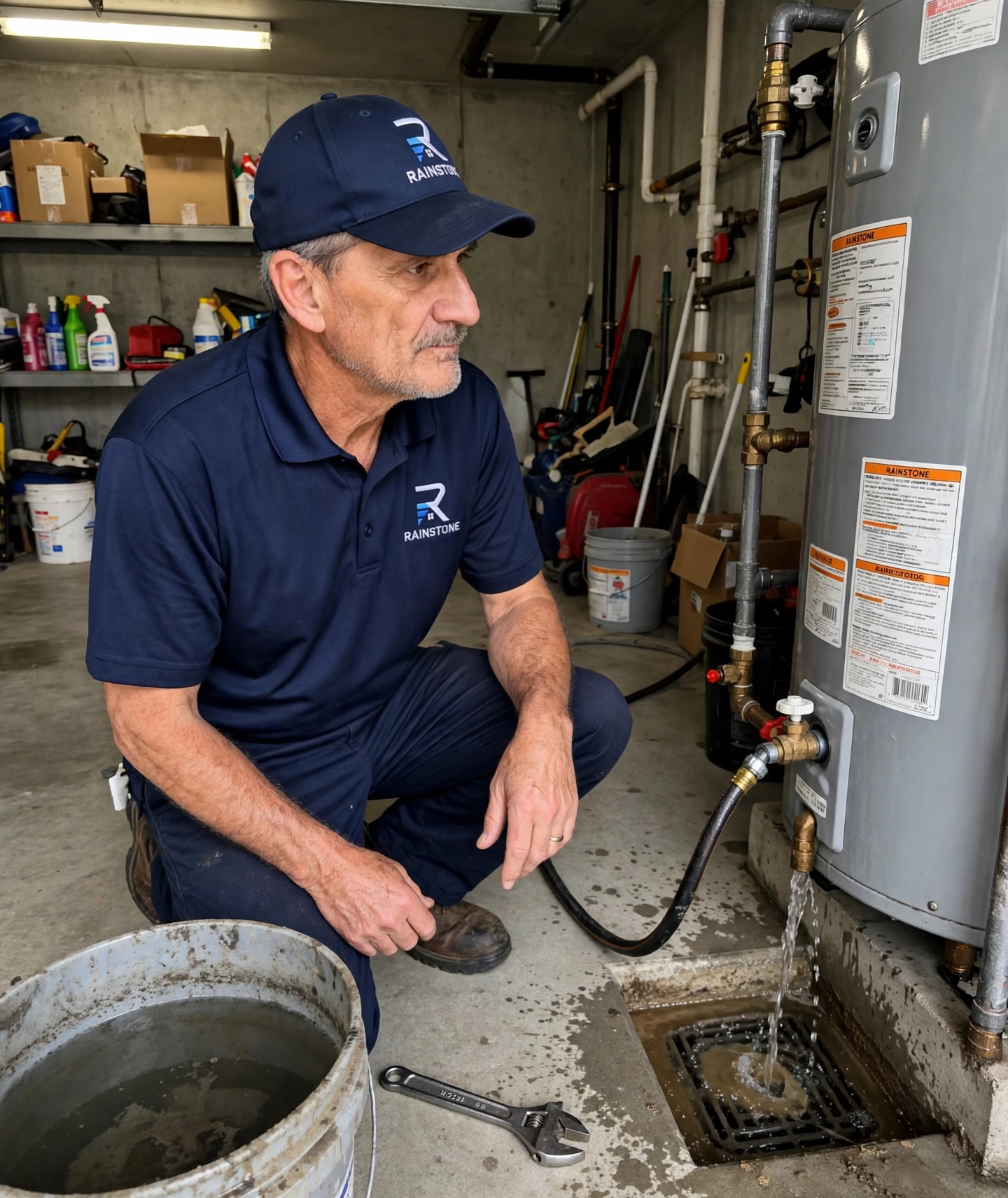
Pflugerville’s water heaters work in the same hard Central Texas water as the rest of the Round Rock area, and the city’s 1990s and 2000s subdivision belt is now deep into second- and third-heater territory. Our Round Rock crew serves Pflugerville daily — from the older streets near the East Main Street Historic District to the family homes of Blackhawk and Falcon Pointe — and attic-placed tanks that cannot be allowed to fail quietly are a big part of the local picture.
Sediment is the slow problem here, and an attic installation is what turns it into an expensive one: a rumbling tank that gets ignored eventually leaks where it can do the most damage. Our $125 service call covers a full diagnosis — tank, venting, valves, and connections — and we quote the repair in writing before work begins. When a flush and a fresh anode rod will buy real years, that is what we recommend; when the tank is honestly done, we will show you the evidence and walk through the options on our Round Rock water heater replacement page.
Pflugerville homeowners can see everything our Round Rock office handles, from annual maintenance that keeps sediment from shortening a tank’s life to tankless sizing for larger households. We are open 5 AM to 11 PM, seven days a week — call 512-881-9603.
Book Your Pflugerville Water Heaters Company Service With Rainstone Water Heaters
Pflugerville’s combination of farm-town history, a mature subdivision belt entering its replacement years, and toll-corridor growth creates steady, varied water heater work. At Rainstone Water Heaters, we bring locally informed water heater installation, repair, maintenance, and replacement to every type of Pflugerville property. Call us at (512) 881-9603 to book your Pflugerville service today.
Our Round Rock team looks after Pflugerville homeowners — see Round Rock water heater services for every repair, replacement, and installation we offer nearby.
For an independent cross-check on the numbers above: the U.S. Department of Energy’s homeowner guidance puts a conventional storage water heater’s service life at roughly 10–15 years and recommends a thermostat setting of 120°F. The lifespan and price figures in our table are the ones Rainstone publishes in its own Texas cost guides — and the ones we stand behind on every written quote.
And for the statewide picture, our Texas water heater services hub pulls together every service we offer across Texas.