
Cedar Park is the established anchor of Austin’s northwest corridor — a city of 77,595 people at the 2020 census, sitting west of Round Rock along US-183 and the 183A toll road, where the suburbs begin to give way to Hill Country limestone and cedar. Its housing stock is the profile a water heater company learns to respect: substantial neighborhoods of 1990s and 2000s family homes in Twin Creeks, Buttercup Creek, and the Ranch at Brushy Creek, typical homes dating to around the turn of the century, and newer growth still pushing north and west. Homes of that age are living on second water heaters, and the quality of the replacement decision — sizing, placement, maintenance — decides whether the next decade is quiet or expensive. At Rainstone Water Heaters, our Round Rock crews serve Cedar Park as part of their home territory. Call us today at (512) 881-9603 to book a service with your Cedar Park water heater company.
Cedar Park’s Established Neighborhoods: A City in Its Replacement Years
Kurt’s take: In Houston I ran service crews of as many as 30 plumbers as a production manager, and I learned to spot a shortcut from across a parking lot. Cedar Park’s neighborhoods were built in waves, and those waves are now arriving at replacement age together. When a whole street’s heaters were installed the same year, the smart move is to plan yours before the street’s failures start setting your schedule for you. When we leave, the job carries a warranty, and the home is left as clean as we found it — if not cleaner.
Twin Creeks, Buttercup Creek, and the 1990s Family Subdivisions
Cedar Park’s defining neighborhoods were built for families and built to last — Twin Creeks around its golf course, Buttercup Creek and Cypress Creek along the creek corridors, and the streets feeding Anderson Mill Road and Lakeline Boulevard. These are predominantly owner-occupied, two-story homes, and their water heaters were typically installed in garages and, in a share of the two-story plans, in attic and upstairs locations where a failure announces itself through a ceiling rather than a puddle.
A typical Cedar Park home dates to around 2001, which places its plumbing squarely in a particular service window: old enough that original fixtures and first replacements are both aging, young enough that the house itself has decades left. The water heater decision in these homes should be made with that horizon in mind — a properly sized, properly maintained unit is a ten-to-fifteen-year answer, and we quote it, in writing, as exactly that.
The Ranch at Brushy Creek and the Brushy Creek Corridor
Along Brushy Creek, on Cedar Park’s eastern side, the Ranch at Brushy Creek and its neighboring communities sit up against the same creekside trail and park system — Brushy Creek Lake Park and the regional trail — that ties this side of the city to Round Rock. The homes are larger, the households are busy, and the hot water demand follows the arithmetic of big families: back-to-back showers, soaking tubs, and laundry that never quite ends.
In these houses the common failure is not age but capacity — a standard tank that was adequate for the builder’s brochure and inadequate for the family that actually moved in. When showers run cold in sequence, we have the sizing conversation honestly, including whether tankless, properly sized to the household’s real peak demand, is the right answer or an expensive way to solve a simpler problem.
The H-E-B Center, Lakeline, and Cedar Park’s Commercial Corridor
Cedar Park works as well as it sleeps. The H-E-B Center anchors an entertainment district that hosts the Texas Stars and Austin Spurs and a year-round calendar of events; the Lakeline retail district spreads along the city’s southern edge; and the medical, office, and restaurant corridors along 183A and Bell Boulevard keep their own hot water demands running on commercial schedules. A water heater failure in these properties is measured in closed kitchens and dark restrooms, not inconvenience.
Our commercial service in Cedar Park is planned around that reality: systems assessed as systems, replacements scheduled ahead of failure where the calendar allows, and emergency response that understands a Friday-night event crowd does not reschedule. The Austin Community College Cypress Creek Campus and the corridor’s clinics and hotels get the same documented, quote-first standard as every other property we serve.
Limestone Water and Northwest-Corridor Living: The Cedar Park Service Picture
Kurt’s take: My standing rule on every job I sign for is simple: leave the home as clean as it was in the beginning, if not cleaner. Limestone water in the northwest corridor coats heating elements and settles in tanks faster than most homeowners expect. An annual flush sounds like a small thing until you price the alternative — it is the cheapest year of heater life a Cedar Park family can buy. That standard does not change with the size of the house or the size of the ticket, because my license is on both. — Kurt Pinkerton, Responsible Master Plumber, Lic. # M-21546
Hard Water at the Edge of the Hill Country
Cedar Park’s water shares the northern metro’s limestone character, and the mineral load does its usual patient work: sediment settling in tanks until recovery times stretch and burners run long, scale building on tankless heat exchangers until the unit protests. What differs here is the housing age curve — with so much of the city built between the early 1990s and the late 2000s, a large share of Cedar Park’s heaters are in exactly the years when neglected maintenance stops being a theory and becomes a replacement bill.
The remedy is unglamorous and completely effective: flush the tank on schedule, check the anode rod before it is spent, descale tankless equipment before it locks out. Our $125 service call reads the whole system — sediment, anode, venting, valves — and our recommendations follow what we find, not what we would prefer to sell.
Attics, Garages, and the Placement Decisions of the Building Boom
Where a water heater sits decides how its old age goes. Cedar Park’s garage installations fail politely — a leak on concrete, contained and visible. Its attic and upstairs installations fail expensively, and the city’s stock includes enough of them that we treat placement as a first-order question on every visit: Is there a drain pan? Does it drain anywhere? How old is the unit sitting over the living room ceiling?
For homeowners replacing an attic unit, we talk through the protective details that cost little at installation and save a ceiling later — pans, drains, leak detection, and a maintenance schedule that catches decline early. It is the kind of unglamorous counsel a homeowner only appreciates once, and then completely.
Owner-Occupied and Settled: Maintenance as a Household Habit
Cedar Park’s households skew settled and owner-occupied in its established neighborhoods, with a median household income of $129,545 and a median owner-occupied home value of $513,600 in recent Census Bureau figures — families who maintain their homes as long-term assets. For households like these, the right water heater relationship is a calendar, not a crisis: annual service, documented condition, and a replacement planned in a chosen month rather than forced in a flooded one.
That is the pattern we build with Cedar Park customers — a service history that follows the house, honest notice when a unit enters its final years, and a written quote ready before the decision is urgent. Settled neighborhoods deserve settled, predictable service, and that is what our Round Rock office sends down US-183 every day.
Water Heater Services in Cedar Park
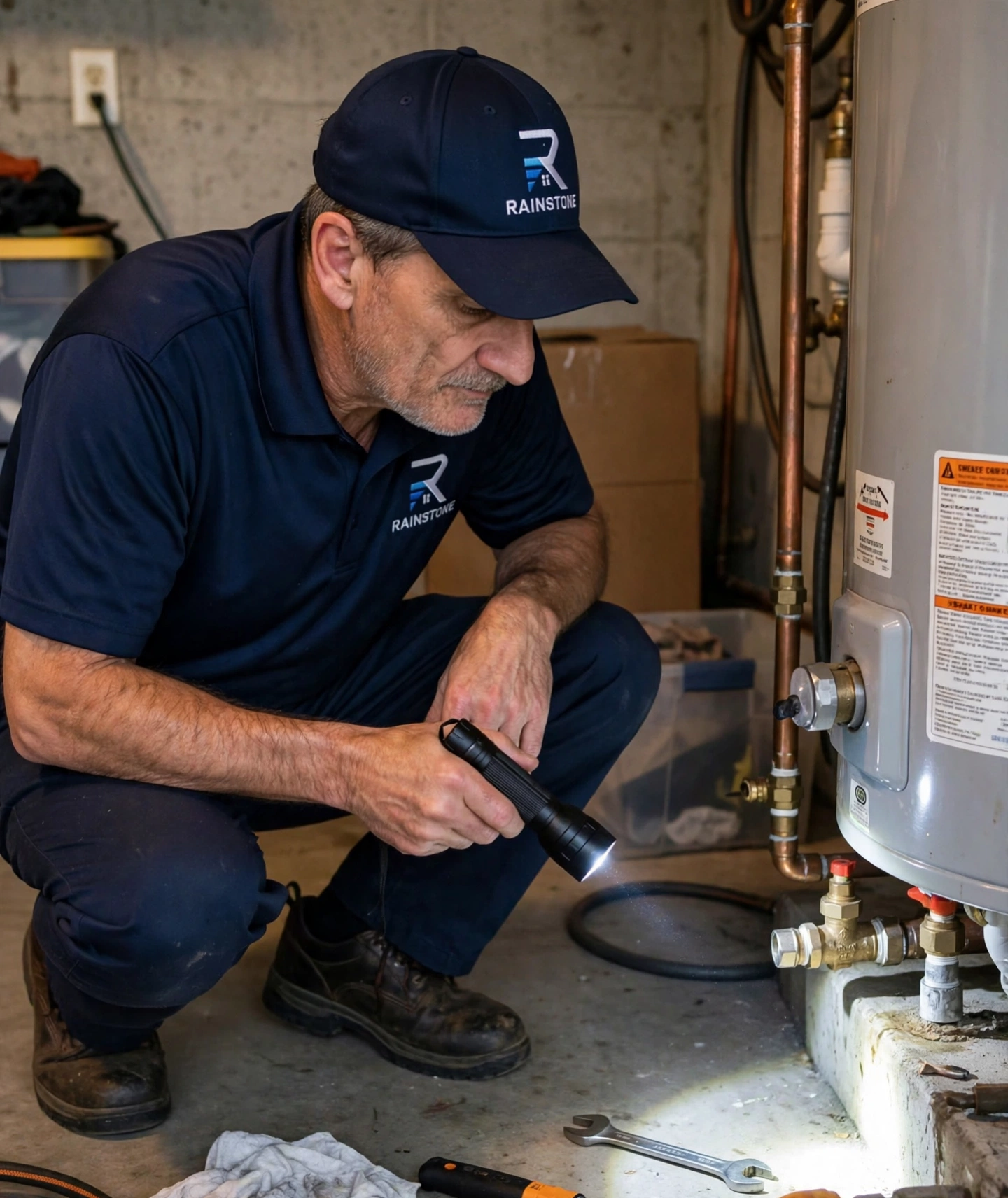
Cedar Park’s housing stock — big, established neighborhoods of 1990s and 2000s family homes from Twin Creeks to the Ranch at Brushy Creek — is deep into its replacement years, and its limestone-country water makes sure no heater gets there gently. Our Round Rock crew serves Cedar Park along the US-183 corridor, and the local work is dominated by one question: repair this unit honestly, or replace it before its placement turns a failure into a ceiling repair?
A $125 Rainstone service call answers that question with evidence. We inspect the tank or exchanger, the sediment load, the anode, the venting, and the drain protection, then quote the fix in writing before any work begins. Many Cedar Park tanks have real years left once they are flushed and maintained on schedule — our Round Rock maintenance service exists for exactly that — and we will tell you so when the tank in front of us says so.
Everything we offer Cedar Park runs through our Round Rock office, open 5 AM to 11 PM, seven days a week. Call 512-881-9603 and talk to the team that will actually send your technician.
Contact Your Cedar Park Water Heaters Company — Rainstone Water Heaters
Cedar Park’s combination of established family neighborhoods, a mature replacement market, and a working commercial corridor makes it one of the most varied service areas our Round Rock office covers. At Rainstone Water Heaters, we bring locally informed water heater installation, repair, maintenance, and replacement to every type of Cedar Park property. Call us at (512) 881-9603 to book your Cedar Park service today.
We serve Cedar Park from our Round Rock office — you’ll find every repair, replacement, and installation we offer on our Round Rock water heater services page.
For an independent cross-check on the numbers above: the U.S. Department of Energy’s homeowner guidance puts a conventional storage water heater’s service life at roughly 10–15 years and recommends a thermostat setting of 120°F. The lifespan and price figures in our table are the ones Rainstone publishes in its own Texas cost guides — and the ones we stand behind on every written quote.
For the full picture of how we work nearby, our Texas water heater services hub pulls together every service we offer across Texas.