
Tankless water heaters are a genuinely compelling technology for many Garland households, but the path to a successful tankless installation in this city is shaped by a factor that rarely applies in newer suburban markets: the condition and capacity of the existing infrastructure that the new unit will depend on. In Garland’s older properties, a tankless installation is frequently not simply a matter of removing the old tank and connecting a new on-demand unit — it is a project that must address gas line capacity, venting configuration, and, in some cases, electrical panel sufficiency before the tankless unit can perform as designed. At Rainstone Water Heaters, we assess every Garland property individually before recommending or proceeding with a tankless installation, ensuring that the prerequisites are genuinely in place and that the completed installation will deliver the continuous hot water performance and energy savings that make tankless a worthwhile investment. Call us at (817) 580-8562 to book a service today.
Tankless is the right answer for a lot of Texas homes — and the wrong answer for some, which is exactly why the conversation matters more than the brochure. I am Kurt Pinkerton, Rainstone’s responsible master plumber. Here in Garland, my team works out of our Garland office, and the standard is the one I set: a $125 service call, a written quote before work begins, and no surprises on the invoice. Call us at 817-580-8562.
What Garland Properties Need Before a Tankless Installation Can Proceed
Kurt’s take: I have headed A-Servco here in Dallas as its master plumber for decades, with permits under my license running from 1991 to 2025 — a record you do not build on shortcuts. Tankless units reward honesty about demand. A household that runs two showers, a dishwasher, and a laundry cycle at once will find the true capacity of an undersized unit on its first Saturday — the sizing conversation has to happen before the installation, not after. DFW ice storms write their own chapter here: a hard freeze finds every marginal joint and tired valve in Garland’s older homes, usually in the same week, usually at night. My rule for the crew is the one I was taught: give the homeowner the honest repair-versus-replace math, even when the honest answer is the smaller ticket.
Gas Line Capacity Assessment and Upgrade Requirements for Garland Tankless Installations
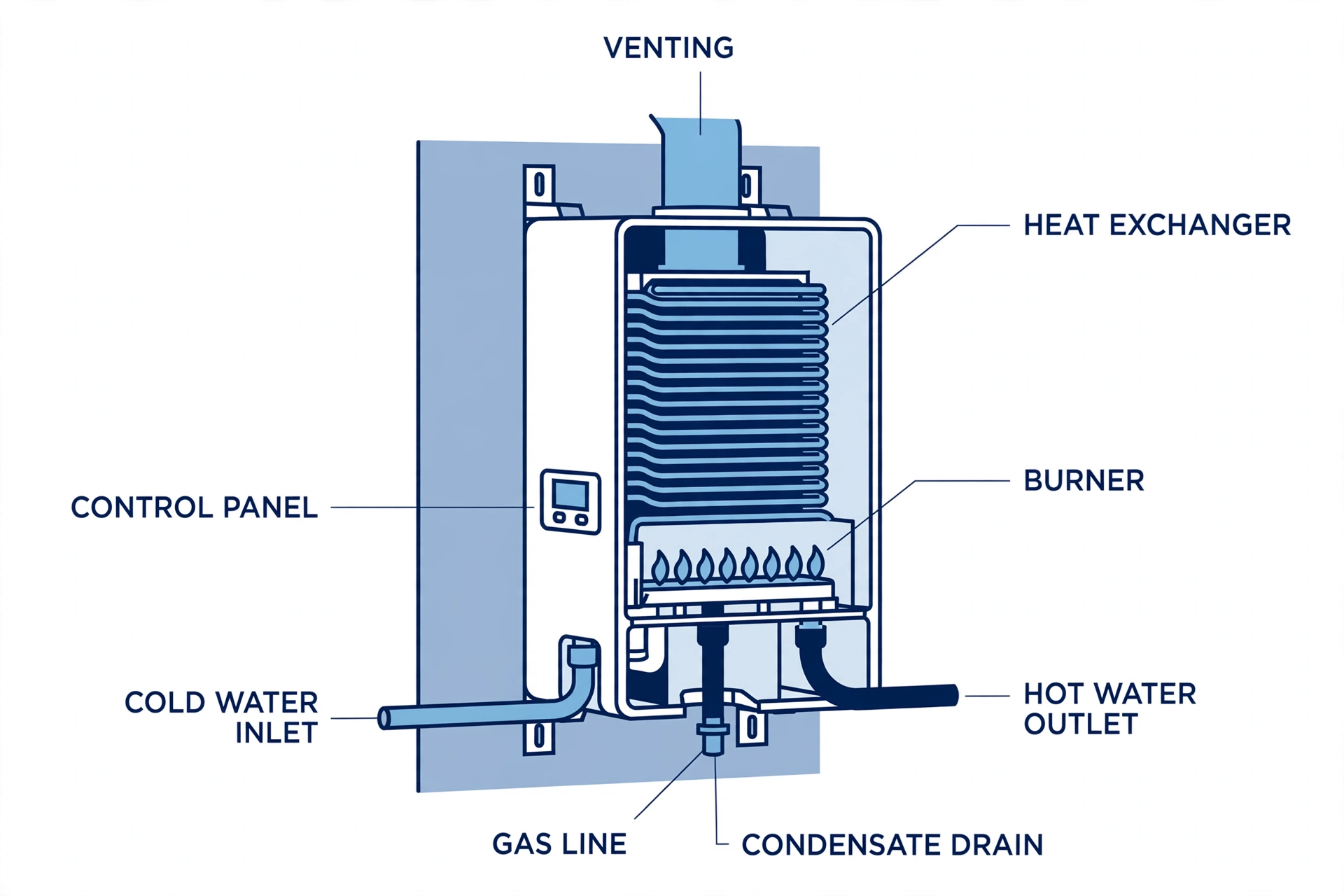
A gas tankless water heater fires its burner at a substantially higher BTU rate than a conventional storage tank unit of comparable capacity, because it must heat water rapidly on demand rather than maintaining a stored volume at temperature with a lower continuous heat input. This higher peak BTU demand requires a gas supply line with sufficient diameter and pressure capacity to deliver the necessary gas volume at the unit’s maximum firing rate without producing a pressure drop that affects the unit’s performance or the other gas appliances sharing the same supply branch. In Garland’s brick ranch properties from the 1960s and 1970s, the gas line supplying the water heater was sized for the modest BTU demand of a conventional storage tank unit — typically in the 30,000 to 40,000 BTU per hour range — and may not have the capacity to supply the 150,000 to 200,000 BTU per hour that a high-output residential gas tankless unit demands at full fire.
Our technicians carry out a gas line capacity assessment as a prerequisite step of every Garland tankless consultation, measuring the available gas pressure at the proposed installation point, confirming the diameter of the supply branch, and calculating whether the existing supply can meet the tankless unit’s peak demand alongside the other gas loads on the same system. Where the existing gas line cannot support the tankless BTU demand, a gas line upgrade is required before the installation can proceed — an upgrade that adds to the total project cost and that must be factored into the homeowner’s decision about whether tankless is the right replacement choice for their specific property. According to the National Fire Protection Association’s NFPA 54 National Fuel Gas Code, gas piping must be sized to deliver the maximum BTU load required by the connected appliances without creating pressure conditions that affect safe and reliable operation, a requirement that makes the gas line capacity assessment a non-negotiable prerequisite rather than an optional preliminary step.
Venting Configuration Changes Required for Tankless in Garland’s Legacy Flue Environments
Gas tankless water heaters are available in atmospheric draft, power vent, and direct vent configurations, and the correct configuration for any specific Garland installation is determined by the venting options available at the installation site. In Garland’s older homes, where existing flue venting may consist of single-wall sheet metal or atmospheric chimney flues that served the original storage tank unit, a conventional atmospheric draft tankless unit may not be compatible with the existing venting arrangement — either because the flue diameter does not match the tankless unit’s requirements, because the flue material does not meet the temperature rating for the tankless unit’s exhaust, or because the existing chimney flue is shared with other appliances in a configuration that creates a back-draft risk. In these situations, a power vent or direct vent tankless unit that creates its own dedicated venting pathway through the exterior wall is often the most practical option, because it eliminates the dependency on the existing legacy flue entirely.
The additional venting infrastructure cost of a power vent or direct vent installation — the PVC vent pipe, the exterior wall penetration, and the terminal fitting — is a real cost that our team includes in the complete project cost comparison when presenting tankless as a replacement option in Garland’s older homes. Homeowners who understand the complete installation cost, including any required gas line upgrade and venting modification, can make an accurate comparison between a tankless installation and a conventional tank replacement with infrastructure remediation, choosing the option that best fits their budget and long-term performance goals rather than comparing a tankless unit price against a like-for-like tank replacement cost that omits the legacy infrastructure issues both options must address.
Electrical Panel Assessment for Electric Tankless Options in Garland’s Older Homes
Whole-home electric tankless water heaters require a significant electrical supply — typically 240 volts at 60 to 150 amperes, depending on the unit’s capacity and the household’s demand requirements — that exceeds what most of Garland’s older electrical panels can provide without a panel upgrade. Garland Power and Light, as the city’s municipal electric utility, would need to coordinate any service upgrade required to support a whole-home electric tankless installation in an older Garland property where the existing service entrance is insufficient for the additional load. The combined cost of a panel upgrade, a new dedicated circuit, and the tankless unit itself makes whole-home electric tankless a significant investment in Garland’s older homes, and for many homeowners in these properties, a gas tankless unit — where the gas line upgrade required is less expensive than a full electrical panel upgrade — is the more cost-effective path to tankless technology. Point-of-use electric tankless units, which serve a single fixture rather than the whole home, remain an accessible option in older Garland properties without these electrical infrastructure prerequisites and are worth considering for homeowners who want the benefits of on-demand heating at a specific high-use point, such as a kitchen sink or a frequently used bathroom.
Tankless Viability and Maintenance Across Garland’s Different Property Types
Kurt’s take: My faith is not something I preach on a job. It just means my word has to match my work, even on the days nobody is watching. Tankless pricing runs $4,800–$6,000 installed for a whole-home unit, and the number only makes sense alongside the maintenance truth: in hard water, a tankless heater that is never descaled is a short-lived one, whatever the brochure promised. Our Garland crews run 5 AM to 11 PM, seven days a week, because Garland’s heaters have never once agreed to fail only during office hours. That is why every job I sign for starts with a written quote before work begins — no surprises after the fact. — Kurt Pinkerton, Responsible Master Plumber, Lic. # M-21546
Tankless in Garland’s Older Mid-Century Properties: A Case-by-Case Evaluation
The most important message for Garland homeowners in older mid-century properties who are considering a tankless upgrade is that viability must be assessed on a property-specific basis rather than assumed from the general appeal of the technology. Some older Garland homes are well-suited to a gas tankless installation with relatively modest infrastructure preparation — a gas line with adequate capacity already in place, an installation space that allows direct vent routing to a nearby exterior wall, and no complicating pipe or electrical conditions that add to the project scope. Others present multiple infrastructure prerequisites that, when their costs are added to the unit cost, make the total project cost comparable to or greater than a well-specified tank replacement with appropriate infrastructure remediation. Our team is honest about this comparison in every Garland tankless consultation, presenting the full picture rather than advocating for one technology over another, regardless of what the specific property’s conditions actually support.
For the Garland homeowner who proceeds with a gas tankless installation in an older property after a thorough infrastructure assessment has confirmed viability, the experience that follows is typically a significant improvement over the conventional tank unit it replaced — continuous hot water availability, meaningful energy savings from the elimination of standby heat loss, and a much smaller physical footprint that returns installation space to the homeowner’s use. These benefits are real and lasting in a property whose infrastructure can support them, and our assessment process exists specifically to identify the Garland properties where a tankless installation will deliver on its promise from day one.
Tankless in Garland’s Newer Communities: When the Prerequisites Are Already Met
In Garland’s newer outer neighborhoods — the Firewheel area, the communities adjacent to Sachse, and the residential developments built from the late 1980s onward — the infrastructure prerequisites for a tankless installation are more likely to be already in place or easily addressed without the extensive remediation that older properties require. Newer construction in these areas typically features copper or CPVC plumbing, adequately sized gas supply lines, modern electrical panels with available capacity, and installation spaces where power vent or direct vent routing to the exterior is straightforward. For homeowners in these Garland communities, the tankless decision is much closer to the straightforward technology-and-cost evaluation that it represents in newer suburban markets across the DFW area, and the consultation focuses on unit selection, sizing, and maintenance planning rather than on infrastructure compatibility.
NTMWD Water Quality and Tankless Heat Exchanger Maintenance in Garland
NTMWD surface water from Lake Lavon and Lake Ray Hubbard is classified as moderately hard, a water quality profile that is meaningfully less aggressive for tankless heat exchanger scale accumulation than the very hard water conditions in parts of Texas supplied by carbonate limestone aquifers. In Garland, a properly installed gas tankless unit on an NTMWD supply without water softening needs professional descaling every twelve months to sustain acceptable heat exchanger performance, with the property’s specific supply hardness and the volume of hot water the household processes daily determining how much scale builds up between those annual services. This moderate maintenance requirement is manageable and is substantially less demanding than what a Garland homeowner who had previously owned a tankless unit in a hard-water Texas city might be accustomed to, making tankless ownership in Garland a less maintenance-intensive proposition than the most challenging Texas water supply environments produce. Our service team provides annual descaling and heat exchanger maintenance for Garland tankless owners as a scheduled professional service, keeping units in the performance condition that justifies the technology investment.
Upgrade to a Tankless Water Heater in Garland With Rainstone Water Heaters Today
A tankless water heater is a worthwhile upgrade for many Garland homes, but realizing its benefits requires an installation that is preceded by an honest infrastructure assessment and executed with the care that the technology’s prerequisites demand. At Rainstone Water Heaters, we bring the specific knowledge of Garland’s property types, gas supply conditions, and NTMWD water quality to every tankless consultation we carry out across the city, ensuring that the installations we recommend and complete are the ones that will perform reliably and deliver on the technology’s promise in each specific Garland home. Call us today at (817) 580-8562 to book your consultation and find out whether a tankless system is the right choice for your Garland property.
Tankless Water Heaters in Garland: the numbers we work by
| Tankless fact | The number |
|---|---|
| Typical lifespan | 15–20 years — roughly double a standard tank’s 8–12 |
| Typical installed range | $4,800–$6,000 |
| Best configuration | From $4,800 |
| Non-negotiable upkeep | Annual descaling — Texas water is hard, and scale is what kills these units early |
How we handle it, step by step
- We size by flow, not by hope. Simultaneous showers, tubs, and appliances set the gallons-per-minute the unit must deliver.
- We check the gas line and venting honestly. If your home cannot feed a tankless unit without major work, the quote shows that work — or we recommend a tank.
- We install and commission — temperature set, flow tested at the fixtures, error codes clear.
- We descale it every year, which is what turns a 15-year promise into a 20-year unit.
For an independent cross-check on the numbers above: the U.S. Department of Energy’s homeowner guidance puts a conventional storage water heater’s service life at roughly 10–15 years and recommends a thermostat setting of 120°F. The lifespan and price figures in our table are the ones Rainstone publishes in its own Texas cost guides — and the ones we stand behind on every written quote.
More water heater services in Garland
- Water Heater Repairs in Garland
- Water Heater Replacement in Garland
- Water Heater Installation in Garland
- Water Heater Maintenance in Garland
- Water Heater Inspections in Garland
- Emergency Water Heater Repairs in Garland
- Leak Detection in Garland
- Commercial Water Heaters in Garland
We keep local homes in hot water all year — take a look at our Garland water heater services for the complete list.