
Water heater leak detection in Garland presents challenges that arise directly from the city’s housing stock characteristics: the mix of pier-and-beam and slab foundation properties across different eras of construction, the galvanized pipe infrastructure in older homes that can produce leak points adjacent to the water heater without the water heater being the actual source, and the enclosed utility room installations common in mid-century properties where leaks can develop and persist in confined spaces for extended periods before producing a visible external indicator. At Rainstone Water Heaters, we carry out water heater leak detection across Garland with a specific understanding of how these housing and infrastructure conditions shape where leaks occur, how they travel, and where the evidence of their presence most reliably appears. Call us today at (817) 580-8562 to book a service if you suspect your water heater is leaking.
Water finds the path you cannot see, and by the time a water heater leak shows itself, it has usually been traveling for a while. I am Kurt Pinkerton, Rainstone’s responsible master plumber — leak work is detective work, and we treat it that way. Here in Garland, my team works out of our Garland office, and the standard is the one I set: a $125 service call, a written quote before work begins, and no surprises on the invoice. Call us at 817-580-8562.
Foundation Type and Its Effect on How Water Heater Leaks Travel in Garland Homes
Kurt’s take: I am a grandfather, and I am bringing my own grandkids into this trade — so I think about the family on the other side of a water heater a little differently than a man who is just selling a job. Water goes where it wants, and the stain on the ceiling is rarely under the source. Tracing a leak is patient work — fittings, valves, the tank body itself — and anyone who pronounces a verdict from the doorway is guessing with your drywall. DFW ice storms write their own chapter here: a hard freeze finds every marginal joint and tired valve in Garland’s older homes, usually in the same week, usually at night. So on my jobs the permit gets pulled and the inspection gets passed, even on the houses where nobody would have checked.
Pier-and-Beam Foundations in Garland: Leak Behavior Beneath a Raised Floor
Garland’s older residential areas contain a meaningful proportion of pier-and-beam foundation properties — homes whose floor structure sits on a raised system of piers and beams, creating a crawl space between the floor and the ground beneath the house. In these properties, the water heater is typically installed in an interior utility room whose floor surface is part of the raised floor structure, and any leak at the water heater connection points or from the unit itself can follow one of two pathways: pooling on the utility room’s raised floor surface where it becomes visible relatively quickly, or infiltrating the raised floor structure and draining into the crawl space below where it can accumulate, saturate framing and insulation, and promote mold growth without producing any visible surface indication at the utility room floor level for an extended period.
The crawl space pathway is the more concerning scenario in Garland’s pier-and-beam homes, because the moisture introduced into the crawl space by a slow water heater leak creates conditions that are favorable to wood-destroying organism activity and mold colonization in the floor framing and subfloor materials that a visible surface leak would not affect. Our leak detection approach in Garland’s pier-and-beam properties includes an assessment of whether the water heater’s installation area shows any signs of moisture that could be tracking into the crawl space below, using moisture meter readings on the floor material at the perimeter of the installation area and, where access permits, a visual check of the crawl space immediately beneath the water heater’s position to identify any evidence of active or historic moisture introduction from above.
Slab Foundation Garland Homes: Leak Travel and Concrete Saturation in Older Properties
Garland’s slab foundation homes — predominantly those built from the late 1970s onward in the city’s outer neighborhoods, including the Firewheel area and the communities adjacent to Garland’s border with Sachse and Rowlett — present a different leak detection context where water heater leaks manifest on a concrete surface rather than on a raised floor structure. In these properties, a slow drip from a water heater fitting follows the garage slab’s gradient toward the nearest drainage point or accumulates in a low area of the floor, creating a moisture pattern that is, in principle, visible but that in a functioning garage environment may be dismissed as tracked-in rain or vehicle condensate rather than recognized as evidence of an active plumbing leak. The mineral staining that NTMWD water leaves on concrete as it evaporates — a characteristic calcium carbonate ring deposit that builds progressively at the perimeter of each evaporation event — is one of the more reliable physical indicators of a slow but ongoing water heater leak on a Garland garage slab.
For properties with particularly old concrete slabs that have developed cracks or construction joint gaps from decades of Dallas County soil movement — a dynamic that the region’s expansive clay soils drive actively — a slow water heater leak that consistently pools at the same slab location can infiltrate beneath the slab through these existing cracks, introducing moisture to the subgrade and potentially contributing to the soil movement conditions that cause the slab cracking to worsen over time. The City of Garland Water Utilities makes monthly water consumption data available to property owners through its customer account portal, and monitoring for an unexplained upward trend in monthly usage is a tool that City of Garland Water Utilities encourages homeowners to use as an early indicator of undetected household leaks before they reach the point of visible damage.
Enclosed Utility Room Leak Tracing in Garland’s Mid-Century Brick Ranch Properties
The indoor utility room water heater installations common in Garland’s mid-century brick ranch properties present a specific leak detection challenge: the enclosed nature of the installation space concentrates any moisture from a leaking fitting within a confined area bounded by drywall, tile, or wood-panel surfaces on three or four sides. Moisture that enters these wall surfaces from a slow leak inside the utility room can wick upward and laterally through the wall material over time, producing surface staining or softness at locations that are not immediately adjacent to the leak source and that could easily be attributed to condensation or roof drainage rather than to a water heater connection fault. In some older Garland utility rooms where the wall finish is original to the property’s construction, moisture-induced deterioration of the wall surface may already be advanced before any visible external sign appears at the utility room doorway or in the adjacent interior rooms.
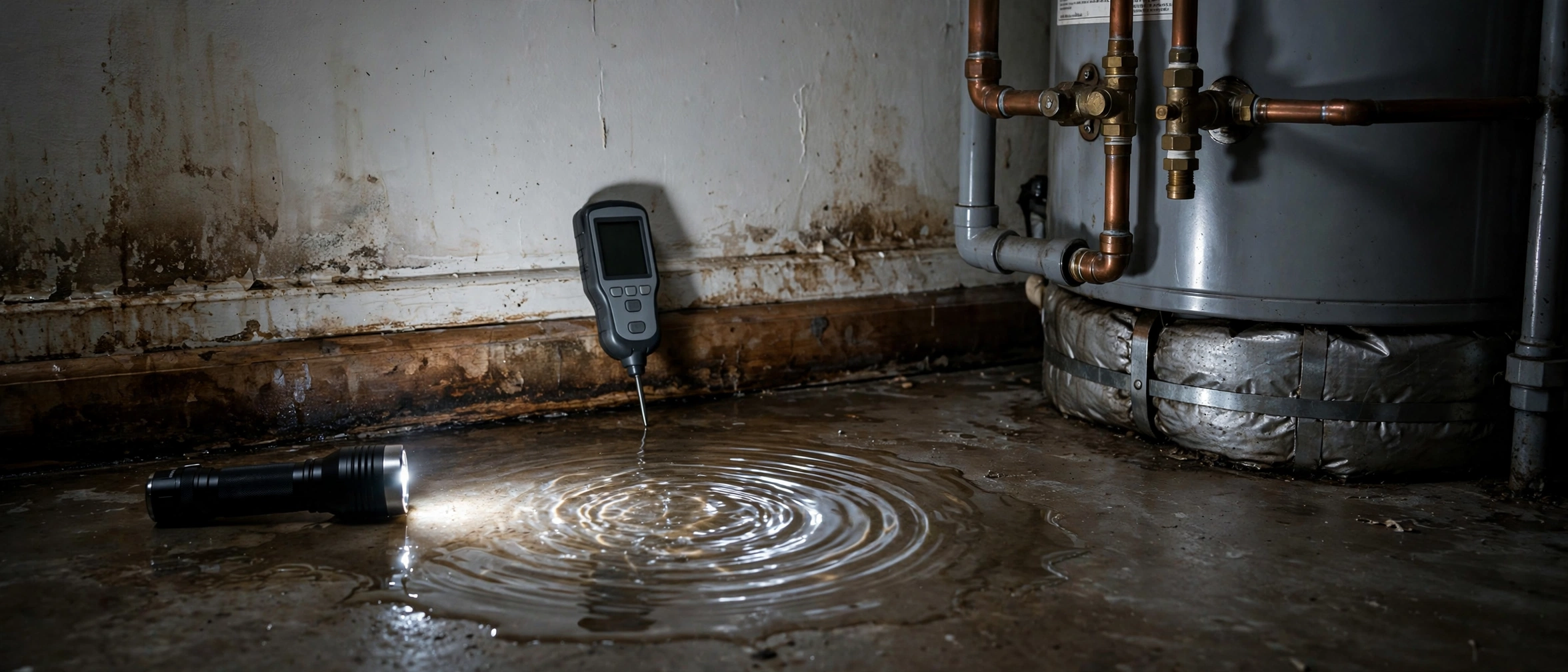
Our leak detection procedure in Garland’s enclosed utility room installations is more detailed than a standard connection point and valve check, because the enclosed space means that evidence of a leak may have traveled significantly from its source before becoming visible. We assess the condition of the wall surfaces within the utility room for moisture staining, softness, or mold discoloration that would indicate sustained moisture exposure, and we check the floor surface and the wall base for any mineral staining pattern consistent with repeated pooling and evaporation of NTMWD water at a specific leak point. Where the visible evidence is ambiguous, our technicians use a moisture meter to confirm whether the wall materials contain elevated moisture levels that support the presence of an active or historic leak, providing an objective measurement rather than a subjective visual assessment that the enclosed space’s limited natural lighting might otherwise make unreliable.
Galvanized Pipe Complications and Leak Source Identification in Older Garland Properties
Kurt’s take: Here is what 38 years teaches a man: the expensive failures almost always start as cheap ones somebody decided to ignore. Never let anyone sell you a water heater for a leak they have not traced. I have seen sound tanks condemned for a failed fitting that cost less than the service call, and I have made our crew show the homeowner the actual source before we quote the actual fix. Our Garland crews run 5 AM to 11 PM, seven days a week, because Garland’s heaters have never once agreed to fail only during office hours. When we leave, the job carries a warranty, and the home is left as clean as we found it — if not cleaner. — Kurt Pinkerton, Responsible Master Plumber, Lic. # M-21546
When the Leak Source Is the Galvanized Pipe, Not the Water Heater
One of the most frequent leak detection findings that surprises Garland homeowners is the discovery that the moisture near their water heater is not originating from the water heater itself but from the galvanized steel supply pipe in the immediate vicinity of the unit. Galvanized pipe that has corroded through its interior zinc coating and begun losing wall thickness from internal rust accumulation can develop pinhole leaks at any point along its length, and the section closest to the water heater — where thermal cycling stress and the higher-temperature operating environment of the hot water side exacerbate the corrosion rate — is frequently the first section to develop an active pinhole leak. The water that escapes a pinhole in this galvanized section runs along the pipe surface, drops onto the floor, and accumulates in a pattern that is indistinguishable from a water heater fitting leak to any visual inspection that does not trace the moisture pathway back to its origin point on the pipe surface.
The significance of this distinction is considerable for the repair scope that follows the detection. A water heater fitting leak is typically resolved by replacing the specific fitting — a modest repair that may not require any work on the surrounding pipe infrastructure. A galvanized pipe pinhole leak requires replacement of the affected pipe section and, depending on the condition of the surrounding galvanized runs, potentially a broader re-pipe of the water heater’s supply circuit. Providing a Garland homeowner with an accurate identification of which of these scenarios they are facing — rather than replacing fittings that are not the source of the problem — is one of the most practically useful outcomes of a professional leak detection service and one that saves the homeowner from the frustration of a repair that does not resolve the leak because it addresses the wrong component.
Post-Ice Event Leak Detection in Garland’s Older Homes
Post-ice event leak discovery is a recurring pattern in Garland’s older homes following significant DFW winter storms, where the thermal stress of the freeze-thaw temperature cycle pushes compromised fittings — particularly at the water heater connection points and at any galvanized pipe joint in the vicinity — past the threshold where they can hold their seal under normal operating pressure. The leak that appears in the days following an ice event in one of Garland’s older properties is frequently not a new fault created by the ice event but an existing weakness that the event’s mechanical stress has activated. This distinction matters for the detection approach: a post-ice event leak in an older Garland home warrants a broader assessment of the surrounding connection point and pipe conditions than the visible leak point alone, because the same ice event stress that activated the visible leak may have brought adjacent fittings to a similarly marginal condition that will produce their own leaks at the next significant temperature cycle.
Our post-event leak detection visits in Garland address this broader risk by assessing all connection points and accessible pipe sections in the water heater’s immediate vicinity for any signs of stress-induced deterioration, not just the connection point that is visibly leaking when we arrive. This comprehensive approach is more useful to the homeowner than a targeted repair that resolves the visible leak while leaving adjacent compromised connections to manifest as the next emergency call, and it is the approach that genuinely protects older Garland properties from the cycle of repeated post-storm leaks that deferred infrastructure assessment produces.

Contact Rainstone Water Heaters for Leak Detection in Garland Today
If moisture near your Garland water heater is raising questions you cannot answer with a visual inspection alone — whether it is a slow drip in a utility room, a staining pattern on a garage slab, a water bill that is running higher than expected, or a post-ice event discovery — the team at Rainstone Water Heaters is equipped to trace the source accurately and provide the findings and remediation recommendations that your specific property and infrastructure conditions require. From pier-and-beam homes in South Garland to slab foundation properties in the city’s newer communities, we carry out professional leak detection across the full range of Garland’s residential property stock. Call us today at (817) 580-8562 to book a service and get a definitive answer.
Leak Detection in Garland: the numbers we work by
| Where the water is | What it usually means |
|---|---|
| Pooled under the tank | Tank corrosion or a failed fitting — the unit must be inspected before anyone calls it minor |
| Dripping from the T&P discharge pipe | Pressure or temperature problem — the valve is doing its job and reporting a fault |
| Wet at the top connections | Inlet/outlet fitting or flex-line failure — often repairable if the tank is sound |
| Damp drywall or flooring nearby, unit dry | The leak may be in the line, not the heater — which is why we trace before we quote |
| Detection visit | $125 service call — source identified and written quote for the repair |
How we handle it, step by step
- We start with the water’s story — when it appears, how much, and what changed in the house around the same time.
- We inspect the unit and its connections under pressure, then trace outward along the lines the water could be traveling.
- We separate the source from the symptom. A wet floor is a symptom; the failed fitting two feet away is the source.
- You get the finding and the fix in writing — repair the fitting, or, if the tank itself is weeping, an honest replacement conversation.
For an independent cross-check on the numbers above: the U.S. Department of Energy’s homeowner guidance puts a conventional storage water heater’s service life at roughly 10–15 years and recommends a thermostat setting of 120°F. The lifespan and price figures in our table are the ones Rainstone publishes in its own Texas cost guides — and the ones we stand behind on every written quote.
More water heater services in Garland
- Water Heater Repairs in Garland
- Water Heater Replacement in Garland
- Water Heater Installation in Garland
- Tankless Water Heaters in Garland
- Water Heater Maintenance in Garland
- Water Heater Inspections in Garland
- Emergency Water Heater Repairs in Garland
- Commercial Water Heaters in Garland
See everything we handle in your area — our Garland water heater services page covers every repair, replacement, and installation we offer locally.