
Replacing a water heater in San Antonio involves considerations that go beyond what a generic guide to water heater replacement will cover. The Edwards Aquifer water delivered through the SAWS network compresses the effective service life of water heaters in ways that matter for timing the replacement decision correctly. City of San Antonio Development Services administers a permit process that applies to residential water heater work and that differs in important ways from the generalized state requirements. And the city’s mix of protected historic homes, mid-century neighborhoods, and rapidly built suburban communities creates genuinely different replacement contexts that call for different unit selections and installation approaches. At Rainstone Water Heaters, we guide San Antonio homeowners through every aspect of the replacement process with a clear understanding of the local conditions that shape the right decision. Call us today at (210) 972-1022 to book a service and start the conversation.
Replacement is the biggest decision a water heater ever asks of you, and it should be made on numbers, not on a salesman’s urgency. I am Kurt Pinkerton, Rainstone’s responsible master plumber — here is exactly how we help homeowners make that call. Here in San Antonio, my team works out of our San Antonio office, and the standard is the one I set: a $125 service call, a written quote before work begins, and no surprises on the invoice. Call us at 210-972-1022.
How San Antonio’s Water Conditions Compress Water Heater Lifespans and Shape Replacement Timing
Kurt’s take: Thirty-eight years in this trade — 27 of them carrying a master plumber’s license — teaches a man to read a water heater closet the way other men read a weather report. Replacement is where shortcuts hide — in the permit nobody pulled, the venting nobody corrected, the pan nobody installed. A tank swapped in an afternoon can carry a decade of consequences, which is why I read a replacement as a small construction project, not a delivery. Hard water is the co-author of every service decision in this city: it shortens timelines, narrows margins, and makes maintenance the main event rather than the footnote. It is also why our $125 service call is waived in full when you go ahead with any replacement — a diagnosis should never feel like a trap.
Why San Antonio Water Heaters Reach End of Life Sooner Than National Averages Suggest
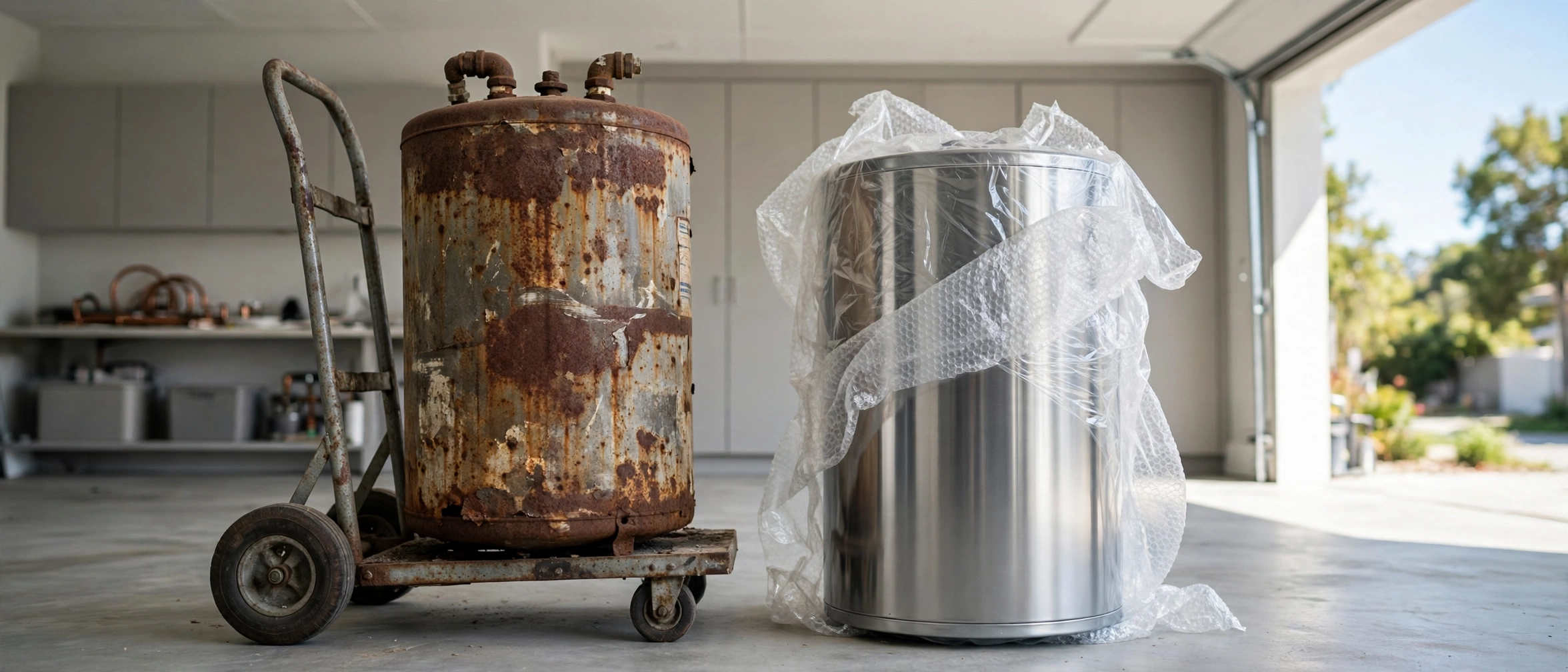
In San Antonio, where Edwards Aquifer water delivers consistently elevated mineral concentrations to every residential property on the SAWS distribution network, the effective service life of a conventional storage-tank water heater is typically shorter than the eight to twelve-year national industry average suggests. The industry average is calculated across a wide range of water supply conditions, from very soft municipal water in cities supplied by surface reservoirs to moderately hard groundwater sources, and it blends out the effect of extreme cases at both ends of the hardness spectrum. San Antonio sits firmly at the high end of that spectrum, and the water heaters serving the city accumulate corrosive wear at a rate that places them at the shorter end of any lifespan range before additional maintenance factors are even considered.
For practical planning purposes, San Antonio homeowners without whole-home water softeners should treat a storage-tank water heater as a ten-year planning horizon rather than a twelve-year one, and consider the last two or three years of that horizon as a period of elevated replacement readiness rather than continued assured service. This is not pessimism — it is an accurate reflection of what the data from San Antonio water heater service histories shows about when units in this environment begin to generate repair frequency and severity levels that make replacement the better financial choice. Entering the replacement process as a planned decision rather than an emergency response gives San Antonio homeowners better pricing options, more unit selection time, and the ability to coordinate the installation at a time of their own choosing rather than amid the disruption of a sudden failure.
Recognizing When Hard Water Damage Has Made Repair Uneconomical in San Antonio
In a San Antonio water heater that has been operating without regular maintenance, the damage caused by Edwards Aquifer hard water tends to manifest across multiple components simultaneously rather than in isolated faults. A unit that presents with a failed heating element may also have a heavily depleted anode rod, a drain valve that cannot be opened due to sediment blockage, and a pressure relief valve that shows signs of mineral-induced seating failure. Each of these issues is individually repairable, but the combination creates a repair scope that, when honestly costed and set against the unit’s age and remaining life expectancy, frequently crosses the threshold at which replacement becomes the more financially sound path.
Our technicians assess this scenario at every repair visit in San Antonio, looking at the presenting fault in the context of the unit’s overall condition rather than evaluating it in isolation. A single element replacement on a three-year-old unit in good overall condition is clearly the right call. The same repair on an eight-year-old unit with heavy sediment, a corroded anode, and a weeping drain valve is a very different proposition, and presenting it to the homeowner as a straightforward repair without acknowledging the broader picture is a disservice. We give San Antonio homeowners the complete assessment so they can make the replacement decision with full information rather than discovering six months later that the money spent on the repair was a down payment on a unit that needed replacing anyway.
Internal Corrosion Indicators Specific to High-Mineral Water Environments
The internal corrosion patterns that develop in San Antonio water heaters as a result of prolonged exposure to high-mineral SAWS water have some specific characteristics that differ from the corrosion patterns seen in softer-water environments. In particular, the calcium carbonate deposits that coat the interior surfaces of a San Antonio tank over time create a complex relationship with the underlying steel: the dense scale layer can temporarily slow direct corrosive contact between the steel and the water, but when that scale layer eventually cracks — as it does under the thermal cycling stress of repeated heating and cooling — the exposed steel beneath it corrodes rapidly, often at a rate faster than if the scale layer had never formed at all. This means that a San Antonio tank that appears stable because its scale layer is intact may be concealing rapidly advancing corrosion at the cracks within that layer.
The indicator our technicians look for that most reliably signals this condition is rust-tinted or reddish-brown hot water that appears intermittently rather than consistently, often first thing in the morning after the water has stood in the tank overnight. This pattern of intermittent discoloration, as distinct from consistently rusty water that more obviously signals an active corrosion problem, is characteristic of a tank whose scale layer has cracked and is allowing episodic rust particle release into the water column. San Antonio homeowners who report this symptom to our team are advised to treat it as a meaningful replacement indicator rather than a minor nuisance, because it signals that the tank’s structural integrity is actively deteriorating in a way that cannot be reversed through repair or treatment.
Calculating the True Remaining Service Life of a San Antonio Water Heater
One of the most practical questions a San Antonio homeowner can ask when facing a replacement decision is how to estimate how much serviceable life their current unit actually has remaining, taking into account both its calendar age and the specific conditions it has been operating in. Our technicians approach this assessment by combining three lines of evidence: the unit’s installation date and total years in service, the maintenance history of the unit and whether regular servicing has extended its effective life beyond the baseline, and the physical findings from a direct inspection of the key wear indicators, including anode rod condition, sediment layer density, and any signs of tank body corrosion. Together, these three factors allow a more informed estimate of remaining life than calendar age alone provides.
A San Antonio water heater that was installed ten years ago but has been maintained annually, with regular tank flushes, anode rod replacements, and TPR valve checks, may genuinely have several more years of reliable service available, while the same model installed eight years ago with no maintenance history may already be in a condition that makes immediate replacement the more prudent choice. The maintenance history distinction is significant in San Antonio’s hard water environment because the difference between a maintained and an unmaintained unit in SAWS water conditions is considerably greater than it would be in a softer-water supply. Investing in an honest, professional assessment of remaining life before making the replacement decision ensures that neither premature replacement nor prolonged operation of a failing unit results in unnecessary cost for the homeowner.
Energy Efficiency Loss and Its Financial Impact on San Antonio Homeowners
San Antonio’s climate, with summer temperatures regularly exceeding one hundred degrees and year-round reliance on hot water for showering, cooking, and laundry in a city of more than one and a half million people, means that the energy cost of heating water is a constant and meaningful household expense. A water heater that was operating at its rated efficiency when new but has since accumulated sediment, scale, and component degradation may be consuming fifteen to thirty percent more energy per gallon of hot water produced than it did at installation, depending on the degree of mineral accumulation and the nature of the efficiency losses involved. This ongoing energy penalty is real money leaving the household budget every month and adds up significantly over the years that a deteriorating unit continues to operate.
The energy efficiency improvement available from replacing an aging, scale-affected unit with a modern high-efficiency equivalent is one of the most compelling financial arguments for a timely replacement in San Antonio. Current federal efficiency standards require new water heaters to meet substantially higher energy factor thresholds than models manufactured a decade ago, and the best available units in each category perform well above those minimums. The gap between the actual operational efficiency of a worn San Antonio water heater and the efficiency of a modern replacement is often larger than homeowners expect, and the monthly energy savings from making that swap can offset a meaningful portion of the replacement cost over the life of the new unit.
City of San Antonio Permits, SAWS Programs, and Local Replacement Incentives
Kurt’s take: I have trained more than 25 people from their first day holding a wrench all the way to journeyman, and several of them run plumbing companies of their own today. The numbers deserve to be plain before work starts: a standard replacement runs $1,850–$2,800 installed, and anything beyond that range should come with a written reason — code work, venting, access — that a homeowner can point to on the quote. From our San Antonio office, that discipline is the whole offer — nothing fancier, and nothing less. My rule for the crew is the one I was taught: give the homeowner the honest repair-versus-replace math, even when the honest answer is the smaller ticket. — Kurt Pinkerton, Responsible Master Plumber, Lic. # M-21546
Navigating the City of San Antonio Development Services Permit Process
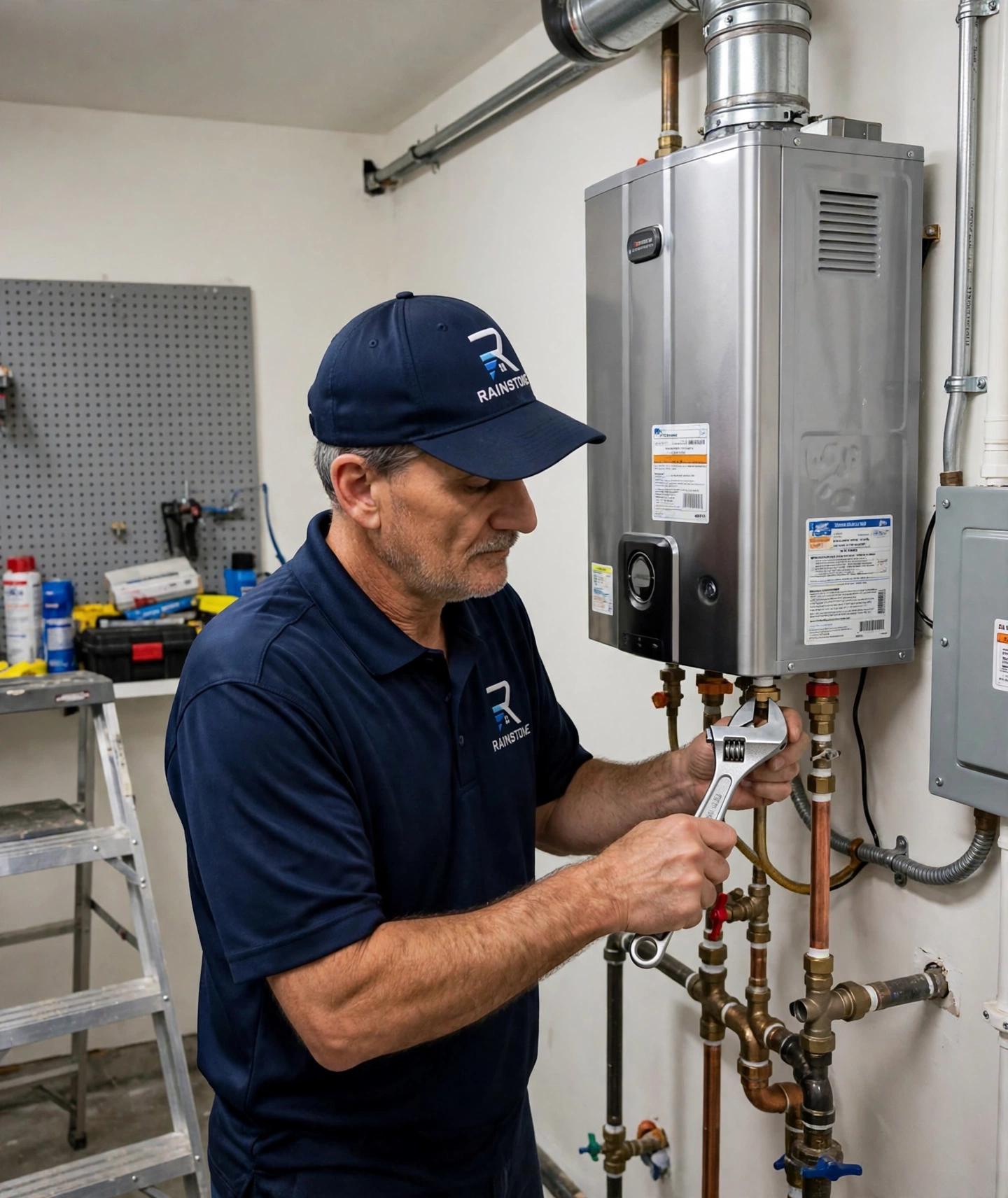
City of San Antonio Development Services requires a permit for water heater replacement work carried out in residential properties within the city’s jurisdiction, and this requirement applies whether the replacement involves a like-for-like unit or a change in fuel type or technology. The permit process exists to ensure that replacement installations are inspected by a City of San Antonio inspector, that the work meets current code requirements, and that the completed installation is documented in the property’s official records. Working with a contractor who handles the permit application and inspection scheduling as part of their replacement service — as Rainstone Water Heaters does — removes this administrative burden from the homeowner entirely and ensures compliance without the homeowner needing to navigate the application process independently.
San Antonio’s position as one of the fastest-growing cities in the United States has created a real estate market where correctly documented home improvements, including permitted water heater replacements, can positively influence property disclosures and transaction processes. Buyers and their inspectors increasingly ask for permit documentation on water heater replacements as part of the due diligence process, and a seller who cannot produce this documentation for a replacement carried out in the past several years may face questions about the installation’s code compliance that complicate the sale. Our team ensures that every replacement we carry out in San Antonio is correctly permitted and fully documented from the outset, protecting both the immediate installation and the homeowner’s longer-term interests in the property.
SAWS Conservation Programs and Water Heater Rebate Opportunities
The San Antonio Water System operates a range of conservation and rebate programs designed to incentivize San Antonio residents and businesses to replace older, less efficient water and energy-using equipment with modern alternatives. While the specific rebate offerings and eligibility criteria for water heater equipment evolve over time, SAWS has historically offered rebates for the installation of qualifying high-efficiency water heaters, including ENERGY STAR-certified models and solar water heating systems. These rebates, combined with the federal tax credits available for qualifying equipment under current energy efficiency incentive programs, can meaningfully reduce the net cost of a water heater replacement for San Antonio homeowners who select eligible equipment.
Our team advises San Antonio homeowners on the current state of available SAWS and federal incentives at the time of their replacement consultation, matching unit selection recommendations to the available programs wherever the recommended unit qualifies. Understanding the full incentive picture before committing to a specific replacement unit can change the cost-effectiveness calculation between different unit types, and homeowners who are on the fence between a standard high-efficiency tank unit and a more expensive heat pump water heater may find that the combined effect of federal credits and SAWS rebates makes the more advanced technology the more financially accessible choice than its higher upfront price would suggest when considered in isolation.
Gas Versus Electric Replacement Given San Antonio’s Energy Infrastructure
San Antonio homeowners choosing a replacement water heater face a fuel type decision that is shaped by the specific energy infrastructure available at their property and the comparative costs of natural gas and electricity in the San Antonio market. Natural gas is widely available across the San Antonio metropolitan area and has historically been the dominant fuel choice for residential water heating in the city, offering faster recovery rates and lower per-unit energy costs than standard electric resistance heating in most scenarios. For homeowners who are already on a natural gas supply and are replacing a gas unit on a like-for-like basis, a gas replacement remains the most straightforward choice in most circumstances, particularly if the installation space, flue routing, and gas supply line are already correctly configured for a gas unit.
Electric alternatives, particularly heat pump water heaters, present a compelling case in San Antonio’s climate for homeowners who are willing to accept a higher upfront cost in exchange for significantly lower ongoing operating costs. Heat pump water heaters draw thermal energy from the surrounding air rather than generating heat directly, and in San Antonio’s warm climate, where ambient temperatures remain conducive to heat pump operation for the majority of the year, these units achieve efficiency levels that substantially exceed gas water heaters in terms of energy cost per unit of heat delivered. For homeowners transitioning away from gas, adding solar generation, or seeking to maximize long-term energy cost reduction, a heat pump water heater is worth serious consideration in the San Antonio context as part of any replacement planning conversation.
Replacement in San Antonio’s Historic Homes Versus New Suburban Construction
Replacement Challenges and Considerations in San Antonio’s Historic Inner-City Homes
Water heater replacement in San Antonio’s historic inner-city properties, including those in neighborhoods protected under the City of San Antonio’s historic district designations, comes with installation constraints that do not apply in standard residential replacement scenarios. Older homes in areas such as the King William Historic District, Mahncke Park, and Beacon Hill were constructed in periods when water heaters were a fraction of their current size, and the spaces originally designated for water heater installation — whether an under-stair closet, a narrow hallway alcove, or a purpose-built utility niche — may not physically accommodate a modern full-size tank unit without modification to the surrounding structure. In historically designated properties, those structural modifications may themselves require design review under the city’s historic preservation guidelines, adding a layer of planning consideration to what would otherwise be a straightforward replacement project.
In these constrained installation environments, a compact or wall-mounted tankless water heater frequently emerges as the most practical replacement option, since its significantly smaller footprint can fit within spaces that a tank unit cannot occupy. Our technicians assess the installation space fully before recommending a replacement unit in any San Antonio historic property, and where the space presents genuine constraints, we provide the homeowner with a clear picture of the options available within those constraints, including the performance trade-offs between a compact tank unit, a point-of-use solution, and a full whole-home tankless installation that routes to a more accessible utility area of the property.
Replacement Options for New Suburban San Antonio Homes: Planning for the Long Term
In San Antonio’s newer suburban communities, where homes are typically built with dedicated water heater installation spaces, properly sized gas supply lines, and modern electrical panels, the replacement decision is less constrained by installation limitations and more focused on choosing the unit that will deliver the best combination of performance, efficiency, and longevity given the local water conditions. These properties offer homeowners the full range of replacement options, from high-efficiency gas tank units to gas condensing tankless systems and heat pump water heaters, and the selection decision can be made on its merits rather than being dominated by physical space or infrastructure constraints.
For suburban San Antonio homeowners making a replacement decision, we encourage planning beyond the immediate replacement to consider what a correctly sized and maintained unit will need over the next decade in the Edwards Aquifer water conditions that will characterize its entire service life. A replacement accompanied by a whole-home water softener installation, for example, meaningfully extends the expected service life of the replacement unit and reduces the frequency of future maintenance interventions in ways that affect the total cost of ownership over the full replacement cycle. Our team incorporates this long-term perspective into every San Antonio replacement consultation, helping homeowners make decisions that serve them not just at the moment of replacement but across the full decade of the new unit’s service life.
Arrange Your Water Heater Replacement in San Antonio With Rainstone Water Heaters Today
A well-timed, correctly specified water heater replacement in San Antonio protects your household from the disruption of a sudden failure, reduces your ongoing energy costs, and positions your property correctly in the city’s active real estate market. At Rainstone Water Heaters, we bring a clear and localized understanding of San Antonio’s replacement landscape — from the Edwards Aquifer’s effect on unit lifespan to the City of San Antonio’s permit process and the SAWS programs that can reduce your replacement cost. Whether your property is in the historic inner city, an established mid-century neighborhood, or a newer suburban community, we are ready to guide you to the right replacement decision with the same honest and thorough approach we bring to every service we provide across the city. Call us today at (210) 972-1022 to book a service and get started.
Water Heater Replacement in San Antonio: the numbers we work by
| Standard tank | Tankless | |
|---|---|---|
| Typical lifespan | 8–12 years | 15–20 years |
| Typical installed range | $1,850–$2,800 | $4,800–$6,000 |
| Replacement tiers | Good $1,850 · Better $2,450 (upgraded tank + expansion tank) | Best from $4,800 |
How we handle it, step by step
- We check the age first. The serial label on your current unit tells us its manufacture date — the same check our free online toolkit walks you through.
- We size for your household, not for the ticket. Occupants, bathrooms, and peak-hour demand decide the size; a bigger invoice does not.
- We handle the permit and the code work. Most Texas cities require a permit for a water heater replacement, and the installation is done to current code — pan, expansion, venting, and T&P discharge included.
- We haul the old unit away and walk you through the new one — temperature setting, shut-off locations, and what your warranty covers.
For an independent cross-check on the numbers above: the U.S. Department of Energy’s homeowner guidance puts a conventional storage water heater’s service life at roughly 10–15 years and recommends a thermostat setting of 120°F. The lifespan and price figures in our table are the ones Rainstone publishes in its own Texas cost guides — and the ones we stand behind on every written quote.
More water heater services in San Antonio
- Water Heater Repairs in San Antonio
- Water Heater Installation in San Antonio
- Tankless Water Heaters in San Antonio
- Water Heater Maintenance in San Antonio
- Water Heater Inspections in San Antonio
- Emergency Water Heater Repairs in San Antonio
- Leak Detection in San Antonio
- Commercial Water Heaters in San Antonio
Browse our San Antonio water heater services to see the full range of repairs, replacements, and installations we handle near you.