
Tankless water heaters are an excellent fit for San Antonio homes in many respects — their compact profile suits the constrained installation spaces common in the city’s older neighborhoods, their on-demand heating aligns well with the varied hot water demand patterns of San Antonio households, and their longer service life is an advantage in a city where water heater replacement timelines are compressed by hard water conditions. But Edwards Aquifer water is a genuinely challenging environment for a tankless unit’s heat exchanger, and San Antonio homeowners who invest in a tankless system without understanding and planning for that challenge may find that their unit underperforms well before it should. At Rainstone Water Heaters, we install, service, and advise on tankless water heaters across San Antonio with the specific water quality knowledge that maximizes long-term performance. Call us at (210) 972-1022 to book a service today.
Tankless is the right answer for a lot of Texas homes — and the wrong answer for some, which is exactly why the conversation matters more than the brochure. I am Kurt Pinkerton, Rainstone’s responsible master plumber. Here in San Antonio, my team works out of our San Antonio office, and the standard is the one I set: a $125 service call, a written quote before work begins, and no surprises on the invoice. Call us at 210-972-1022.
Why Tankless Water Heaters Face Specific Challenges in San Antonio’s Hard Water Environment
Kurt’s take: I am a grandfather, and I am bringing my own grandkids into this trade — so I think about the family on the other side of a water heater a little differently than a man who is just selling a job. Tankless units reward honesty about demand. A household that runs two showers, a dishwasher, and a laundry cycle at once will find the true capacity of an undersized unit on its first Saturday — the sizing conversation has to happen before the installation, not after. Between historic neighborhoods and fast new subdivisions, San Antonio asks one water heater crew to be fluent in two centuries of housing — sometimes on the same call day. My rule for the crew is the one I was taught: give the homeowner the honest repair-versus-replace math, even when the honest answer is the smaller ticket.
How Edwards Aquifer Mineral Content Affects the Tankless Heat Exchanger
The heat exchanger is the core component of any tankless water heater — the assembly through which cold water passes and is rapidly heated to the target temperature on demand. In a tankless unit, the water is in direct contact with the heat exchanger surfaces throughout the entire heating process, and those surfaces are maintained at high temperatures continuously while the unit is operating. San Antonio’s water, delivered by SAWS from the Edwards Aquifer, carries a high concentration of dissolved calcium and magnesium carbonates that precipitate out of solution and adhere to heated surfaces at a rate that is directly proportional to both the water temperature and the mineral concentration. The heat exchanger’s combination of high operating temperature and continuous water contact makes it one of the most aggressive scale accumulation sites of any component in any water heating system, and in San Antonio’s hard water supply, this accumulation process proceeds considerably faster than in cities with softer water sources.
The practical consequence is that a tankless heat exchanger in a San Antonio property without any water treatment or filtration will begin to show measurable efficiency loss from scale accumulation within twelve to eighteen months of installation, a timeframe that is substantially shorter than the two to three-year descaling interval that manufacturers often suggest as a general guideline for average water conditions. San Antonio’s water hardness is not average by any regional standard, and the maintenance schedule that protects a tankless investment in this city is set by those conditions — a fixed annual descaling — rather than by a generic national average that does not reflect the Edwards Aquifer’s mineral load.
What Happens When Heat Exchanger Scale Is Left Unaddressed
When limescale accumulation in a tankless heat exchanger is allowed to build beyond the point where the unit’s performance begins to decline, the progression of effects follows a recognizable sequence that our technicians see repeatedly in San Antonio units that have missed their descaling service intervals. The first stage is a gradual reduction in the unit’s flow rate at any given temperature setting, as the narrowing of the internal water passages from scale deposits restricts the volume of water the unit can process per minute without a temperature drop. The homeowner notices this as the hot water pressure falling off during a shower or the unit struggling to simultaneously supply two fixtures at the temperature it could previously manage without difficulty.
As the scale layer thickens further, the heat exchanger must operate at progressively higher surface temperatures to push the same heat through the increasingly insulating scale layer into the passing water, creating thermal stress in the heat exchanger material that can eventually cause cracking or delamination of the internal surface. At this stage, the damage goes beyond what descaling can resolve, and the heat exchanger itself requires replacement — a repair that is significantly more expensive than the regular descaling service that would have prevented it. In severe cases, a heavily scaled tankless unit in San Antonio can reach this point of irreversible heat exchanger damage within four to five years of installation if no descaling has been carried out, an outcome that is entirely avoidable with a correctly calibrated maintenance schedule.
Flow Rate Reduction as an Early Warning Sign of Scale Accumulation
San Antonio homeowners with tankless water heaters can monitor their unit’s condition through one accessible performance indicator that does not require any technical expertise to observe: the hot water flow rate at a fixed fixture compared to a baseline established when the unit was newly installed or recently descaled. If the flow rate from a shower or tap that has not otherwise changed, at the same temperature setting, is noticeably lower than it was twelve months ago, scale accumulation in the heat exchanger is the most probable explanation in San Antonio’s water conditions. This observation should prompt a professional descaling service rather than a wait-and-see approach, because the scale layer that has already formed will continue to grow at an accelerating rate as the narrowed passages further concentrate the mineral deposit cycle with each passing week.
In established San Antonio neighborhoods and newer suburban communities alike, tankless water heaters are increasingly chosen for their space-saving profile and the continuous supply they provide. Protecting that investment means responding to performance changes promptly rather than waiting for the unit to develop a fault that requires a repair service rather than a maintenance intervention. Our team advises San Antonio tankless owners to establish a baseline flow rate measurement at the time of installation and to compare it annually as a simple health check that costs nothing and can prevent the need for a much more expensive service call down the line.
Kurt’s take: I am a grandfather, and I am bringing my own grandkids into this trade — so when I talk a San Antonio family into a tankless unit, I am also the man who will answer for that advice in fifteen years. The installed price, $4,800–$6,000 for a whole-home system, only earns its keep if the descaling happens on schedule, because SAWS water will coat a heat exchanger faster than almost any supply in Texas. Skip the flushes and the unit ages in dog years; keep them, and it will still be heating when my grandkids are running calls of their own. That maintenance rhythm is part of the quote conversation at our San Antonio office, not a footnote after it. — Kurt Pinkerton, Responsible Master Plumber, Lic. # M-21546
Descaling Frequency Calibrated to San Antonio Water Conditions
The descaling procedure for a tankless water heater involves circulating a food-grade descaling solution, typically a diluted white vinegar or a commercially prepared citric acid solution, through the heat exchanger under low pump pressure for a period sufficient to dissolve the accumulated calcium carbonate deposits and restore the internal passages to their original cross-section. For most tankless units in average water supply conditions, manufacturers often suggest this service every year or two. San Antonio is not average water: the Edwards Aquifer’s hardness levels require professional descaling every twelve months — a fixed annual interval — for units without any upstream water treatment, precisely because that limestone hardness loads scale onto the heat exchanger faster than softer supplies do. In properties with the highest SAWS hardness readings, a biannual descaling schedule — every six months — may be warranted to prevent the accumulation from reaching efficiency-degrading levels between services.
According to the Water Quality Association, water with hardness levels above ten to fifteen grains per gallon is classified as very hard and can significantly accelerate scale formation in water heating equipment. San Antonio’s SAWS supply frequently exceeds this threshold, placing it in the category where the most proactive descaling schedules are justified. Our technicians document the scale condition of the heat exchanger at each service visit and compare it to the previous observation — and the next descaling is booked twelve months out, on the fixed annual schedule that San Antonio’s Edwards Aquifer water demands. That visit-by-visit record is also how we spot the properties where the highest SAWS hardness readings warrant bringing the interval forward to every six months.
Inlet Filter and Flow Sensor Maintenance in SAWS-Supplied San Antonio Properties
In addition to heat exchanger descaling, tankless water heater maintenance in San Antonio includes regular cleaning of the inlet filter screen, which is positioned at the cold water inlet of the unit and designed to catch particles from the water supply before they enter the heat exchanger. In San Antonio’s hard water supply, the inlet filter accumulates both suspended particles and mineral deposits at a rate that warrants inspection every three to six months rather than the once-yearly check that is often sufficient in softer-water cities. A partially blocked inlet filter reduces the flow rate entering the unit and can cause the unit to enter error mode if the flow falls below the minimum threshold required to trigger a heating cycle, producing a fault code that homeowners sometimes mistake for a mechanical failure when the actual solution is simply a filter cleaning.
The flow sensor inside the tankless unit, which detects when water is flowing and activates the heating system, is another component that can be affected by San Antonio’s water conditions over time. Mineral deposits that enter the unit past a partially blocked filter can accumulate on the flow sensor’s moving parts or sensing surfaces, reducing its sensitivity and causing the unit to activate intermittently or with a delay that produces a momentary cold water slug at the fixture before the heating cycle engages. Our technicians inspect and clean the flow sensor as part of every comprehensive maintenance service on a San Antonio tankless unit, ensuring that the unit’s demand-detection reliability is maintained alongside its heating performance.
Water Softener Integration With Tankless Systems in San Antonio Homes
For San Antonio homeowners who want to protect their tankless water heater investment most effectively over the long term, integrating a whole-home water softener upstream of the unit is the intervention that produces the greatest reduction in scale accumulation rate and heat exchanger maintenance frequency. By exchanging the calcium and magnesium ions that cause scale formation for sodium ions before the water reaches the tankless unit, a properly sized and maintained water softener can reduce the descaling frequency from annual to every two or three years, substantially reducing the lifetime maintenance cost of the system and extending the service life of the heat exchanger. In San Antonio’s hard water supply context, this is not a luxury upgrade — it is a practical investment with a calculable return in the form of reduced maintenance costs and extended equipment life.
Our team advises San Antonio tankless owners on the appropriate softener sizing for their household water usage and the specific hardness level of their SAWS supply zone, ensuring that the softener is set to deliver water at a hardness level that protects the tankless unit without over-softening to the point where the sodium content of the treated water becomes a concern. The correct integration of a water softener with a tankless unit also requires attention to the anode rod material selection in any hybrid system, as the softened water environment calls for a different rod material than the hard water supply without treatment. Our technicians manage these interconnected specifications as part of a whole-system approach to San Antonio water heater performance and longevity.
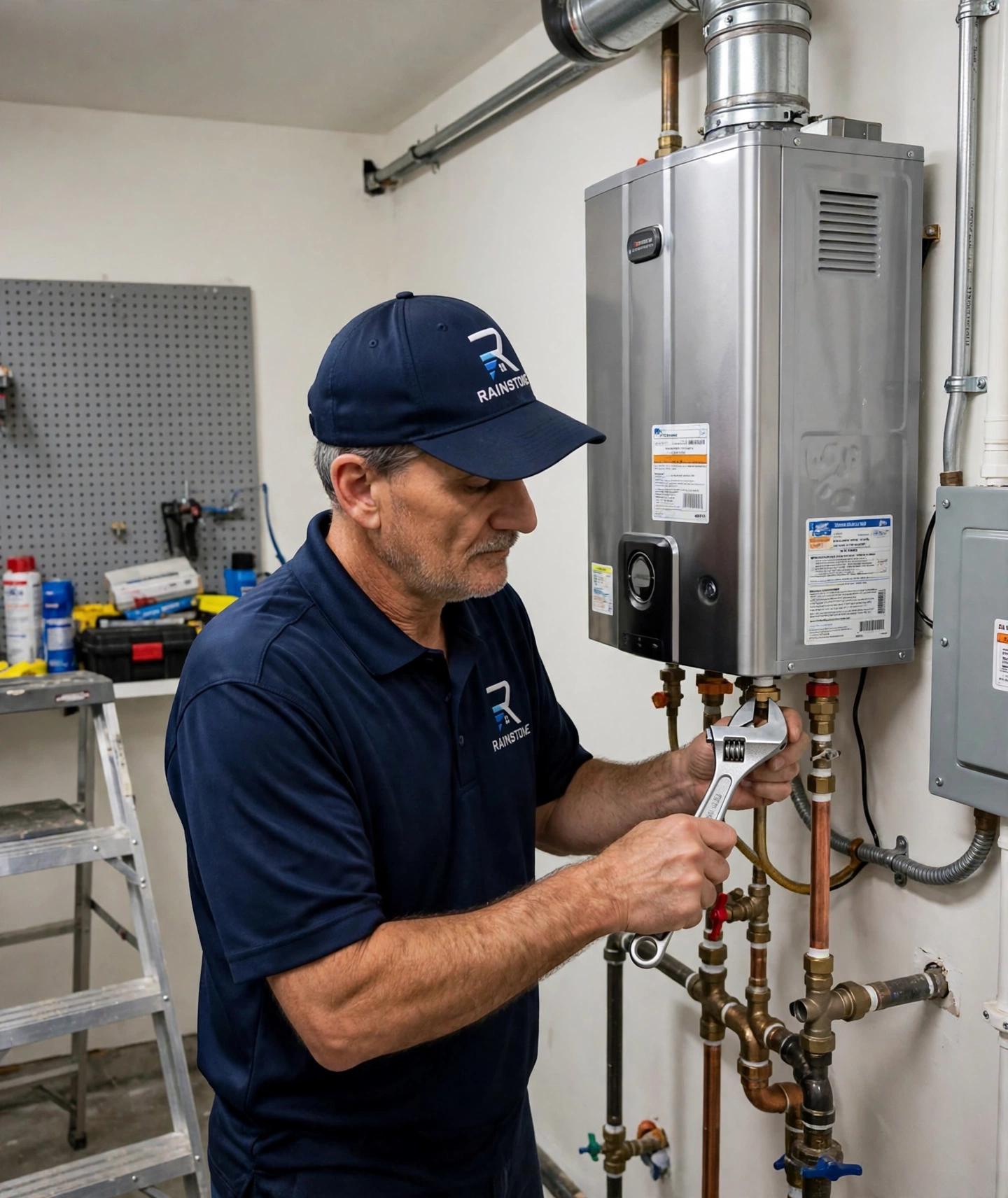
Upgrade to a Tankless Water Heater in San Antonio With Rainstone Water Heaters Today
A tankless water heater is an excellent long-term investment for a San Antonio home, but only when it is installed, maintained, and supported with the right water treatment approach for the city’s specific water conditions. At Rainstone Water Heaters, we bring a precise understanding of how Edwards Aquifer water hardness affects tankless system performance and longevity, and we design our installation and maintenance recommendations around that specific reality rather than around generic guidance that does not account for San Antonio’s water supply. Whether you are considering a tankless upgrade for the first time or are looking to get more reliable performance from an existing unit, our San Antonio team is ready to help. Call us today at (210) 972-1022 to book a service and get the most from your San Antonio tankless system.
Tankless Water Heaters in San Antonio: the numbers we work by
| Tankless fact | The number |
|---|---|
| Typical lifespan | 15–20 years — roughly double a standard tank’s 8–12 |
| Typical installed range | $4,800–$6,000 |
| Best configuration | From $4,800 |
| Non-negotiable upkeep | Annual descaling — Texas water is hard, and scale is what kills these units early |
From the field: a San Antonio household that outgrew its tank
The problem was arithmetic, not failure: a San Antonio household whose mornings had outgrown a single tank — showers, laundry, and dishes queuing for the same forty gallons, with the last person in line getting the cold end of the deal.
The conversation that followed is the one we have before any tankless recommendation: how many bathrooms run at once, how the demand actually stacks up at peak, and what the aquifer’s hard water will ask of the unit every year after. Sized honestly, a tankless fits that house. Sized by brochure, it would have disappointed everyone.
The installation ran under permit, inside the published tankless range of $4,800–$6,000, with the annual descaling rhythm set from day one — the appointment that keeps San Antonio’s water from slowly closing the exchanger down. The outcome the household reports is the unglamorous one that matters: nobody plans a shower anymore.
How we handle it, step by step
- We size by flow, not by hope. Simultaneous showers, tubs, and appliances set the gallons-per-minute the unit must deliver.
- We check the gas line and venting honestly. If your home cannot feed a tankless unit without major work, the quote shows that work — or we recommend a tank.
- We install and commission — temperature set, flow tested at the fixtures, error codes clear.
- We descale it every year, which is what turns a 15-year promise into a 20-year unit.
For an independent cross-check on the numbers above: the U.S. Department of Energy’s homeowner guidance puts a conventional storage water heater’s service life at roughly 10–15 years and recommends a thermostat setting of 120°F. The lifespan and price figures in our table are the ones Rainstone publishes in its own Texas cost guides — and the ones we stand behind on every written quote.
More water heater services in San Antonio
- Water Heater Repairs in San Antonio
- Water Heater Replacement in San Antonio
- Water Heater Installation in San Antonio
- Water Heater Maintenance in San Antonio
- Water Heater Inspections in San Antonio
- Emergency Water Heater Repairs in San Antonio
- Leak Detection in San Antonio
- Commercial Water Heaters in San Antonio
We keep local homes in hot water all year — take a look at our San Antonio water heater services for the complete list.