
Water heater repairs in San Antonio follow a pattern that is shaped as much by the city’s water supply as by the age or model of the unit. The San Antonio Water System delivers water from the Edwards Aquifer that is consistently high in dissolved calcium and magnesium, and the repair calls our technicians receive across the city reflect the toll this places on heating components, connections, and valves over time. From a corroded inlet nipple in a historic Southtown property to a burned-out heating element in a subdivision home in Converse, the fault types and their root causes are predictable once you understand the environment San Antonio water heaters operate in. At Rainstone Water Heaters, we diagnose and repair water heaters across San Antonio with the localized knowledge that makes the difference between a repair that lasts and one that simply delays the same problem from recurring. Call us at (210) 972-1022 to book a service today.
When a water heater fails, the first job is not turning a wrench — it is finding the real fault. I am Kurt Pinkerton, Rainstone’s responsible master plumber, and I have built our repair work around one rule: we diagnose first, quote in writing, and only then repair. Here in San Antonio, my team works out of our San Antonio office, and the standard is the one I set: a $125 service call, a written quote before work begins, and no surprises on the invoice. Call us at 210-972-1022.
Repair Patterns That Emerge in San Antonio Water Heaters Due to SAWS Water Conditions
Kurt’s take: My wife Lezlee and I have been married 33 years, and she will tell you I bring the same stubborn standard home that I bring to a job site. A repair call is won or lost in the diagnosis, before a single part comes off the truck. Thermostats, elements, gas valves, and anode rods all fail with similar symptoms, and the shop that guesses parts at a heater will guess its way through your money too. Between historic neighborhoods and fast new subdivisions, San Antonio asks one water heater crew to be fluent in two centuries of housing — sometimes on the same call day. So on my jobs the permit gets pulled and the inspection gets passed, even on the houses where nobody would have checked.
Heating Element Replacement Driven by Hard Water Scale Accumulation
Of all the repair types our technicians carry out on electric water heaters across San Antonio, heating element replacement is by far the most frequent, and the underlying cause is almost always the same: limescale from SAWS water has accumulated on the element surface to the point where the thermal stress of operating through that insulating layer has caused the element to fail. The failure mechanism is straightforward. As scale builds on the element, the element must run at progressively higher internal temperatures to push the same amount of heat through the scale layer into the surrounding water. Eventually, the sustained high temperature causes the element’s internal nichrome wire to fail or the surrounding sheath to crack, at which point the element stops heating the water and must be replaced. In San Antonio, where SAWS water is consistently classified as hard to very hard, this process happens faster than in most other Texas cities, and heating elements in San Antonio properties without water softeners frequently fail within three to five years of installation rather than the ten to fifteen years that a manufacturer’s rated lifespan would suggest.
Effective element replacement in a San Antonio hard water environment requires more than simply fitting a new element and reconnecting the power supply. The scale that caused the failure has also been accumulating on the interior surfaces of the tank, and leaving it in place while fitting a new element guarantees an accelerated repeat failure. Our technicians carry out a full tank flush as part of every element replacement service in San Antonio, removing as much of the accumulated sediment as possible before the new element is installed, and advising the homeowner on the descaling treatments and maintenance intervals that will help extend the replacement element’s service life beyond what the previous element achieved.
Gas Valve and Thermostat Repairs in Older San Antonio Properties
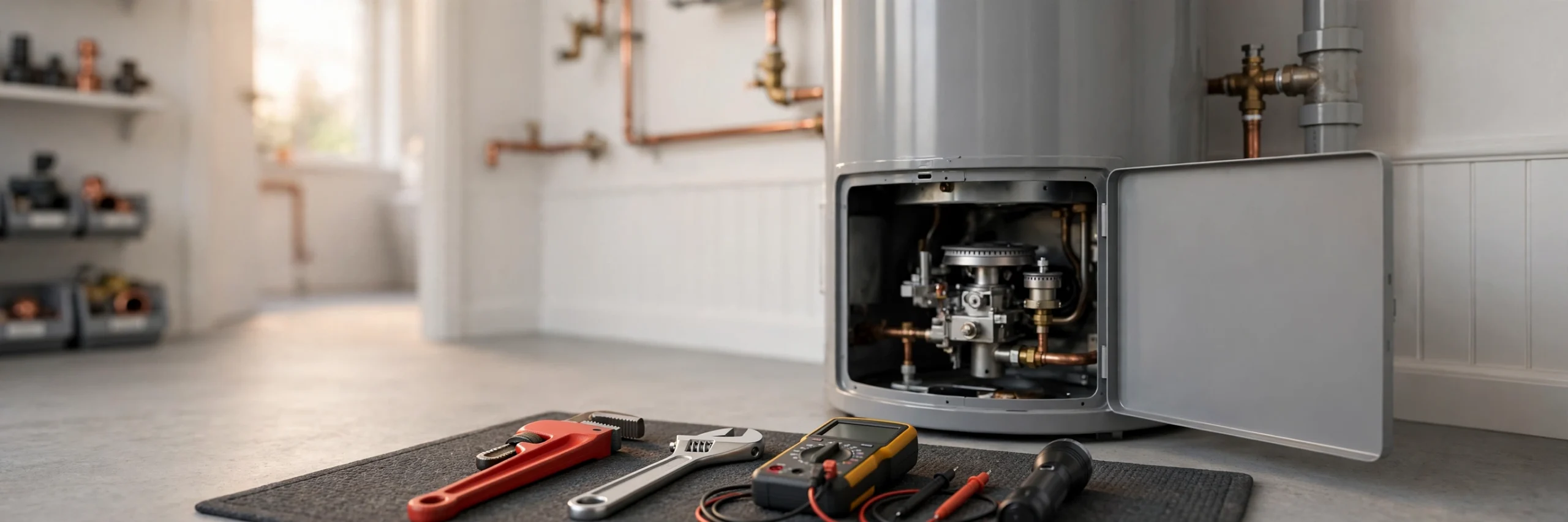
Gas water heaters in San Antonio’s older residential properties, particularly those in neighborhoods built before the 1980s, frequently develop gas valve and thermostat faults that are partly attributable to age and partly to the combined effects of scale accumulation around valve components and the hard water mineral deposits that can infiltrate the gas valve assembly through the thermostat probe immersed in the tank water. A gas valve thermostat that has been in contact with San Antonio’s high-mineral water for many years may show signs of mineral casing around its sensing element, affecting its calibration and producing inconsistent water temperatures or, in more advanced cases, a complete failure to fire the burner. This is a less commonly understood repair scenario than a straightforward thermocouple failure, but it is a recognizable pattern in older San Antonio gas units that our technicians are equipped to diagnose accurately.
Where the gas valve assembly has deteriorated beyond the point where individual component replacement is practical, full gas valve replacement is the appropriate repair. Modern gas control valves for most common water heater brands are available as complete assemblies, and fitting a new valve assembly also addresses any thermostat drift, pilot regulation issues, and igniter control problems that may have been developing alongside the primary fault. Our technicians match replacement valves precisely to the unit’s model specifications, ensuring that the repaired unit operates within its designed parameters after the work is complete rather than being brought back to a marginal functional state that will require further attention in the near term.
Corroded Inlet and Outlet Nipple Replacement
The threaded nipples at the top of a water heater tank, where the cold water inlet and hot water outlet pipes connect to the tank body, are among the most common leak and corrosion repair sites across San Antonio. These nipples are typically constructed from dielectric materials designed to prevent galvanic corrosion at the junction between the steel tank fitting and the copper or galvanized supply pipes, but they remain subject to the mineral-driven corrosion that SAWS water causes at any metal-to-water interface. Over time, mineral deposits accumulate at the threaded joints and within the nipple body itself, and the combination of corrosive chemical exposure and the thermal cycling stress of the heating process causes the nipple material to deteriorate to the point of failure.
San Antonio Water System publishes an annual water quality report that documents the specific mineral concentrations delivered across different zones of the city’s distribution network, and the data it contains confirms the consistently elevated calcium and magnesium hardness levels that our technicians observe as a driver of connection corrosion in the water heaters they repair across the city. Nipple replacement is a relatively straightforward repair when the tank threads are still in good condition, but in older units where the corrosion has progressed to the tank fitting itself, the repair becomes more complex and may influence the recommendation toward replacement of the full unit rather than continued investment in a structurally compromised tank. Our technicians assess this distinction carefully during every repair visit and communicate the finding clearly before proceeding with any work.
Drain Valve Failure and Sediment-Related Flow Blockages
The drain valve at the base of a water heater tank is a component that most San Antonio homeowners never think about until it fails, either by leaking continuously from a deteriorated seat or by becoming so packed with hardened calcium sediment that it can no longer be opened when a flush is attempted. Drain valve leaks in San Antonio water heaters occur with above-average frequency compared to softer-water cities, because the sustained contact between the valve’s rubber seat and high-mineral water causes the seal material to harden and lose its seating capability over time. A continuously dripping drain valve is not simply a nuisance — it represents a slow but ongoing loss of heated water and the energy that was used to heat it, and it will not self-correct without replacement of the valve body.
The second drain valve issue, a blockage caused by hardened sediment, presents a different problem. A valve that cannot be opened means the tank cannot be flushed through the drain point, leaving the accumulated sediment permanently in place and the tank unable to receive the maintenance it needs. In severe cases of sediment blockage, the only way to remove the valve is to turn off the water supply, open a hot water tap at a fixture to relieve pressure, and carefully work the valve free while managing the outflow. Our technicians carry the appropriate tools to address both types of drain valve failure and replace the failed component with a brass ball-style valve that provides significantly better long-term reliability than the plastic valve bodies that are fitted as standard on most mass-market water heaters.
Addressing Water Quality Issues After a Repair Service
After a significant repair to a San Antonio water heater, particularly one that involved tank access, element replacement, or major internal disturbance, it is common for the hot water supply to carry some residual discoloration or unusual taste or odor for the first few hours of resumed operation. This is a normal consequence of disturbing the settled sediment layer at the base of the tank during the repair process, and it does not in itself indicate a further fault with the unit. Our technicians advise homeowners to run hot water at a distant fixture for several minutes following a repair to flush any disturbed material through the system before it reaches sensitive appliances such as dishwashers or washing machines.
In cases where the post-repair water quality does not clear within the first day or two of operation, or where the discoloration is heavy and rust-tinted rather than slightly cloudy, our technicians assess whether the disturbance of the repair has revealed a more significant internal corrosion condition that was previously stable. A repair that effectively resolves the presenting fault but disturbs a settled layer of rust scale on the tank interior can sometimes uncover the degree to which the tank lining has deteriorated, and in these cases the repair finding opens a frank conversation about replacement planning. Our team manages this type of post-repair discovery transparently, giving homeowners accurate information about the unit’s actual internal condition rather than sending them away with a completed repair bill and an unspoken concern about the unit’s longer-term viability.
How San Antonio’s Urban and Suburban Property Mix Creates Different Repair Contexts
Kurt’s take: My name and my license, M-21546, stand behind every job this company signs, so I take sections like this one personally. Before booking a repair, a homeowner deserves to know the unit’s age and the honest math: what this fix costs, what it buys in years, and when the same money belongs in a replacement instead. I would rather lose a repair ticket to that honesty than win one without it. Our San Antonio crews run 5 AM to 11 PM, seven days a week, because this city’s heaters fail on their own schedule, not ours. When we leave, the job carries a warranty, and the home is left as clean as we found it — if not cleaner. — Kurt Pinkerton, Responsible Master Plumber, Lic. # M-21546
Inner-City Neighborhood Repairs: Older Infrastructure and Non-Standard Configurations
Repair calls from San Antonio’s established inner-city neighborhoods, including areas such as Dignowity Hill, Prospect Hill, Denver Heights, and the residential streets immediately west of downtown, frequently involve water heaters installed in non-standard configurations that reflect the building practices of several decades ago. Units may be installed in closets too small to allow convenient access to the top of the tank, where the anode rod port is located. Flue configurations in these properties sometimes involve bends and transitions that exceed current code guidelines but were installed before those standards were adopted. Plumbing connections may be in galvanized steel rather than copper or CPVC, creating a different set of corrosion dynamics at the connection points and a need to assess the condition of the supply pipe at the same time as the water heater fitting itself.
Our technicians approach repairs in these older San Antonio properties with the understanding that the water heater does not exist in isolation — it is connected to a wider plumbing infrastructure that shares the same history of exposure to Edwards Aquifer water and the same accumulation of age-related degradation. A repair that addresses the presenting fault without acknowledging the condition of the connected plumbing is incomplete, and in these neighborhoods, the connected plumbing condition is often a relevant factor in assessing whether a repair investment is likely to produce durable results. We communicate these observations to homeowners as part of every repair visit, ensuring they have a complete picture of their property’s water heating and plumbing health rather than a partial view that is limited to the unit that called them to book a service.
Suburban San Antonio Repairs: Issues in Newer Properties Under Ten Years Old
In rapidly developed suburban communities along Loop 1604, in areas such as Alamo Ranch, Stonewall Estates, Stone Oak, and the communities northeast of San Antonio along US-281, the water heaters are newer but they are not immune to early repair needs, because the Edwards Aquifer water that has served the inner city for generations follows the same distribution network into these newer communities and begins its mineral accumulation from the first day the unit is filled. Homeowners in these suburban areas sometimes assume that a water heater less than five years old should not require any attention beyond the warranty period, and they are often surprised by a heating element failure or a drain valve problem that develops in a unit they consider still new.
Construction-phase water quality issues are a specific repair driver in newer San Antonio suburban properties that is not a factor in established neighborhoods. When a new home’s plumbing system is first pressurized and flushed, the water that fills the pipes and the water heater carries construction debris, pipe flux, and mineral particles from the water system’s own distribution infrastructure. In a high-hardness water supply like San Antonio’s, the initial mineral load on a new water heater is actually higher than it will be once the system stabilizes, because new pipe interior surfaces release their own mineral deposits into the water flow before a stable internal coating has formed. Repair calls resulting from early construction-phase sediment accumulation or element damage from flux residue contact are a recurring pattern in San Antonio’s newer suburbs that our team is specifically positioned to identify and address.
How Understanding SAWS Water Quality Data Helps Anticipate Repair Needs
The San Antonio Water System’s annual water quality report provides detailed measurements of the mineral content, pH, and other characteristics of the water delivered to each zone of the city’s distribution network. For homeowners who want to understand why their water heater is experiencing particular repair issues, or who want to calibrate their maintenance intervals to the actual water conditions at their property rather than a generic guideline, this data is a practical and accessible resource. Higher calcium hardness readings in the SAWS report for a particular service zone translate directly into a shorter recommended interval between heating element checks, anode rod inspections, and sediment flushes for water heaters in that zone.
Our technicians incorporate SAWS water quality context into their repair consultations with San Antonio homeowners, explaining the relationship between the measured hardness at the homeowner’s address and the frequency and type of repairs they should anticipate for their unit type over the coming years. This approach transforms a repair visit from a transactional interaction into an informative consultation that gives the homeowner a more complete understanding of how to manage their water heating investment going forward. Whether you have a standard tank unit in an older San Antonio neighborhood or a newer installation in a growing suburb on the city’s periphery, the same Edwards Aquifer water is the context in which that unit operates, and the repair and maintenance strategy that serves it best is one that is built around that specific reality.
What San Antonio Homeowners Should Know Before Booking a Repair Service
What to Have Ready and What to Expect on the Day of a Repair Visit
Preparing for a water heater repair visit in San Antonio helps our technicians work efficiently and ensures that the homeowner gets the most useful outcome from the service call. Providing as clear a description as possible of the fault symptoms, including when the problem first appeared, whether it was sudden or gradual, and any other changes in the unit’s behavior that preceded or accompanied the primary symptom, gives the diagnosing technician a more complete picture and helps them bring the most likely required parts on the initial visit. Knowing the unit’s approximate age and fuel type — gas or electric — and, if accessible, the model and serial number from the rating plate on the unit, is also useful information to have at hand when making the booking call.
On the day of the repair, our technicians carry out a structured diagnostic process before beginning any work, confirming the specific fault and communicating the findings and the proposed repair approach to the homeowner before proceeding. In San Antonio’s diverse residential landscape, from compact inner-city homes to spacious suburban properties, access to the water heater varies considerably, and our team is experienced in working within the space constraints that San Antonio’s older building stock, in particular, can present. The goal of every repair visit is to leave the homeowner with a unit that is functioning correctly, a clear understanding of what was repaired and why, and a specific recommendation for the next maintenance step that will help prevent the same issue from recurring.
When a Repair Quote Should Prompt a Reconsideration of Replacement
In a city where water heater wear rates are elevated by a consistently hard water supply, the threshold at which replacement becomes more economical than continued repair arrives earlier for many San Antonio homeowners than it would for homeowners in softer-water cities. When a repair estimate for a unit that is already eight or more years old represents fifty percent or more of the cost of a new installation, the economics of continuing to invest in the existing unit are generally unfavorable. The aging unit will likely require further repairs within a shorter time frame than a newer unit would, and it is also operating at a lower energy efficiency level than current models, meaning that every additional year of operation also carries an elevated energy cost compared to the alternative.
Our technicians are transparent about this assessment and raise it proactively when the repair scenario warrants it. A homeowner who understands the full picture — the repair cost, the unit’s age and remaining life expectancy given San Antonio’s water conditions, and the long-term energy savings achievable through replacement — is in a position to make the decision that is genuinely right for their situation. We do not advocate for replacement to increase the scope of a service call. We advocate for it when the numbers, the unit’s condition, and the homeowner’s circumstances make it a more sensible path. Call Rainstone Water Heaters at (210) 972-1022 to book a repair service with a team that will give you an honest and informed assessment from the moment we arrive at your San Antonio property.
Book Your Water Heater Repair in San Antonio With Rainstone Water Heaters Today
San Antonio’s water conditions make professional water heater repair more than just a convenience — they make it a practical necessity for any homeowner who wants to protect the investment in their system and avoid the cycle of repeat faults that inadequately addressed repairs can produce. At Rainstone Water Heaters, we bring a precise understanding of how Edwards Aquifer water chemistry drives the specific faults we see across San Antonio’s diverse residential property stock, from the historic streets of the inner city to the newest suburban communities on the city’s expanding edge. Whether your water heater needs a straightforward component replacement or a more detailed diagnostic assessment, we provide the same standard of thorough, honest, and professionally completed repair work on every visit. Call us today at (210) 972-1022 to book your service and get your San Antonio water heater back in reliable working order.
Water Heater Repairs in San Antonio: the numbers we work by
| Common repair | What you pay | How we handle it |
|---|---|---|
| Diagnosis / service call | $125 | We find the fault and give you a written quote before any repair begins |
| Gas control valve replacement | $615 | One of the most common gas-unit repairs we make — priced flat, not by the hour |
| Heating elements, thermostats, anode rods, T&P valves | Quoted in writing after diagnosis | The $125 service call comes first, so the quote is based on your unit, not a guess over the phone |
How we handle it, step by step
- You call, we come out for a $125 service call. A licensed technician tests the unit — thermostats, elements, gas valve, venting, and the tank itself.
- You get the quote in writing. If a part fixes it, the quote says so. If the tank is gone, we say that instead, and show you why.
- We repair only what you approved. No add-ons appear on the invoice that were not on the quote.
- We test under load before we leave. Hot water at the tap, no leaks at the fittings, and the work area left clean.
For an independent cross-check on the numbers above: the U.S. Department of Energy’s homeowner guidance puts a conventional storage water heater’s service life at roughly 10–15 years and recommends a thermostat setting of 120°F. The lifespan and price figures in our table are the ones Rainstone publishes in its own Texas cost guides — and the ones we stand behind on every written quote.
More water heater services in San Antonio
- Water Heater Replacement in San Antonio
- Water Heater Installation in San Antonio
- Tankless Water Heaters in San Antonio
- Water Heater Maintenance in San Antonio
- Water Heater Inspections in San Antonio
- Emergency Water Heater Repairs in San Antonio
- Leak Detection in San Antonio
- Commercial Water Heaters in San Antonio
See everything we handle in your area — our San Antonio water heater services page covers every repair, replacement, and installation we offer locally.