
Water heater installation in San Antonio is not a one-size-fits-all job. Across a city that ranges from early twentieth-century homes in the historic center to sprawling suburban tracts built in recent decades, the installation environment varies significantly from property to property, and matching the right unit, the right installation approach, and the right venting configuration to each specific context is what separates a professional installation from one that simply gets the water heater connected and leaves the homeowner to discover the consequences later. At Rainstone Water Heaters, we install water heaters across San Antonio with a detailed understanding of the city’s architectural diversity and the code requirements that govern how each installation type must be executed. If you need a water heater installed, call us today at (210) 972-1022 to book a service and speak with our San Antonio installation team.
An installation done right disappears from your life for a decade or more. An installation done cheaply comes back as leaks, code violations, and a warranty argument. I am Kurt Pinkerton, Rainstone’s responsible master plumber, and installation quality is where I am least willing to compromise. Here in San Antonio, my team works out of our San Antonio office, and the standard is the one I set: a $125 service call, a written quote before work begins, and no surprises on the invoice. Call us at 210-972-1022.
Common Water Heater Installation Environments in San Antonio and What Each Requires
Kurt’s take: In Houston I ran service crews of as many as 30 plumbers as a production manager, and I learned to spot a shortcut from across a parking lot. An installation sets the terms for fifteen years of mornings. Sizing, venting, gas or electrical capacity, and placement decide whether a household forgets its water heater or fights it, and none of those decisions can be unmade cheaply once the unit is lit. San Antonio’s SAWS supply is some of the hardest water in Texas, straight off Edwards limestone — it loads tanks with sediment and coats tankless exchangers faster than almost anywhere we work. When we leave, the job carries a warranty, and the home is left as clean as we found it — if not cleaner.
Attic Installations: A Prevalent San Antonio Configuration
San Antonio’s residential architecture includes a high proportion of homes with water heaters installed in the attic space, particularly common in the suburban tracts built across the northside and westside of the city from the 1970s through the 1990s. Attic installations became a favored builder choice during these decades because they kept the water heater out of living areas without requiring a dedicated interior utility room, and the configuration remains widespread enough that any San Antonio installation contractor needs to be fully prepared to work in this environment. An attic water heater installation in San Antonio presents specific technical requirements that do not apply in ground-level or garage installations, beginning with the mandatory installation of a drain pan beneath the unit with a properly routed overflow drain line that directs any leakage or TPR discharge water to a safe external point rather than allowing it to flood the ceiling of the living space below.
The thermal environment of a San Antonio attic is among the most extreme that a water heater can be asked to operate in. During the summer months, attic temperatures in San Antonio regularly reach one hundred and forty degrees Fahrenheit or higher, creating an operating environment that can affect thermostat calibration, accelerate the degradation of insulation on supply pipes, and in the case of heat pump water heaters, exceed the ambient temperature range within which the heat exchange process operates efficiently. Our technicians assess the attic installation environment carefully during any new installation in this configuration, advising on appropriate insulation for exposed supply lines, the suitability of the chosen unit type for the attic’s thermal conditions, and the access requirements for future maintenance visits — a consideration that is easy to overlook at the point of installation but becomes very relevant when a technician needs to reach the top of the unit to inspect the anode rod two years later.
Garage Installations in San Antonio’s Suburban Properties
Garage installations are the most common water heater placement in San Antonio’s newer suburban communities, where attached or detached garages provide a natural utility space that keeps the unit out of the living area while remaining more accessible than an attic location. A water heater installed in a San Antonio garage must be elevated at least eighteen inches above the finished floor level if it is a gas unit with a pilot light or an intermittently igniting burner, because garages are environments where gasoline vapors from stored vehicles can accumulate near floor level and create an ignition risk if the burner flame is positioned at floor height. This elevation requirement applies under both the Texas Plumbing Code and the city’s locally adopted standards, and it is a point of non-negotiable code compliance that our installation team builds into every garage installation from the outset.
The thermal environment of a San Antonio garage also affects installation decisions in ways that are specific to the city’s climate. A garage that is not climate-controlled can reach extreme temperatures in San Antonio’s summer months and occasional sub-freezing temperatures during the cold snaps that periodically affect the region, including the kind of extended freeze event that caused widespread pipe failures across San Antonio in February 2021. For properties in areas of San Antonio that experienced pipe damage during that event, a garage installation in an uninsulated space is a legitimate concern, and our team advises on supplemental pipe insulation and the installation of the unit in the most thermally protected area of the garage space to reduce vulnerability to future cold-weather events.
Interior Closet Installations in Older San Antonio Neighborhoods
In San Antonio’s older established neighborhoods, including areas such as Alamo Heights, Terrell Hills, and the residential streets surrounding the Medical Center district, interior utility closet installations are common. These closets were originally designed for water heaters of a smaller footprint than current models, and an installation involving a modern full-size unit in this type of space requires careful attention to clearance distances from combustible surfaces, combustion air requirements for gas units, and the routing of flue pipe through the closet wall or ceiling to reach the exterior. In some of these properties, the existing closet flue configuration uses materials or routing paths that do not meet current code standards and must be upgraded as part of the installation project rather than simply reused with a new unit.
Our technicians assess interior closet installation spaces thoroughly before any new unit is ordered, confirming that the space can physically accommodate the replacement unit with the required clearances and that the combustion air and venting requirements can be met within the structural constraints of the existing space. Where the closet configuration presents challenges that cannot be resolved without significant alteration to the surrounding structure, we present the homeowner with alternative installation approaches, which may include relocation of the unit to a more suitable space or the substitution of a compact or tankless unit that can be accommodated within the original closet footprint with minimal modification.
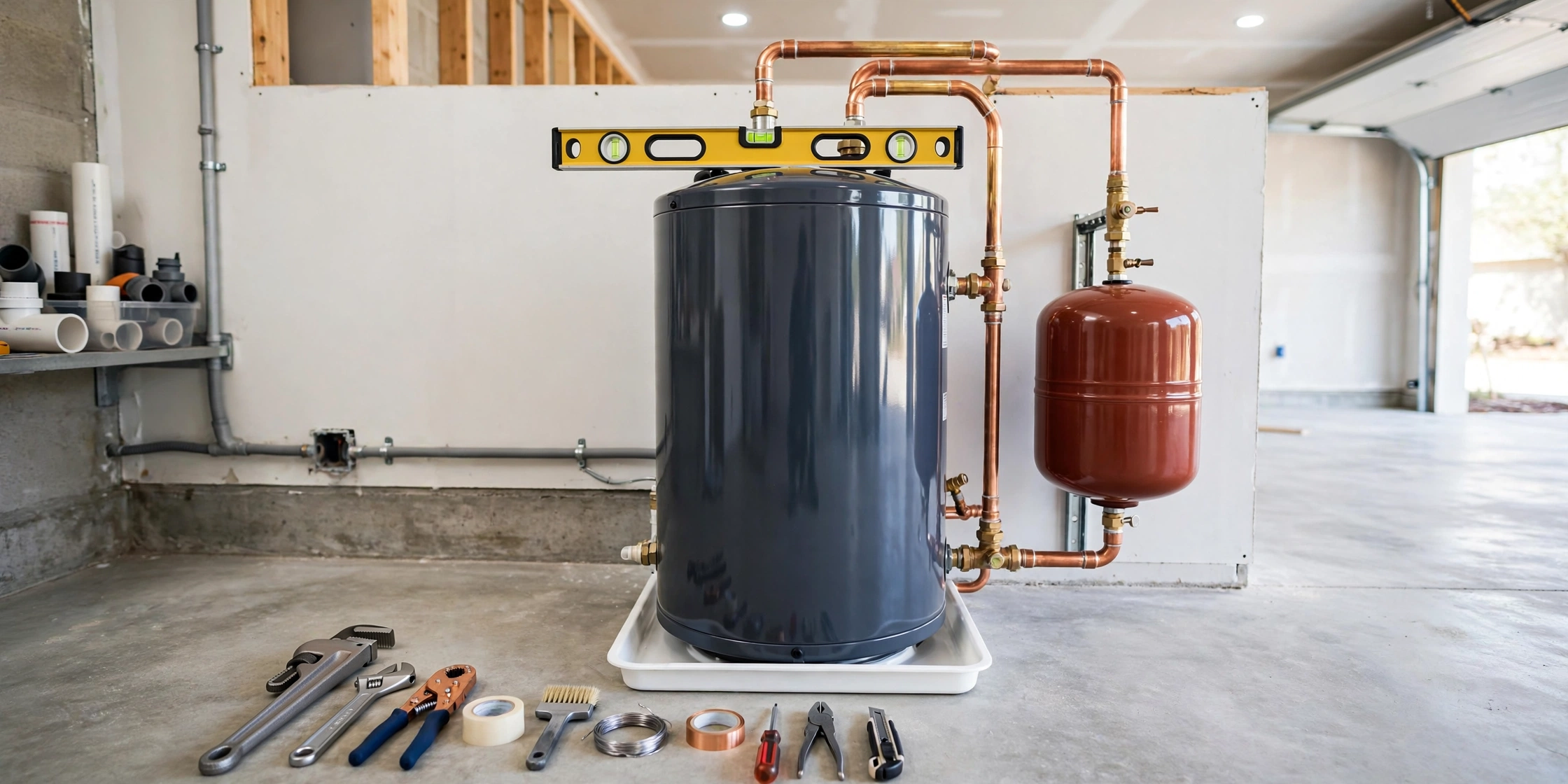
Venting, Code Compliance, and Coordination Specific to San Antonio Installations
Kurt’s take: My standing rule on every job I sign for is simple: leave the home as clean as it was in the beginning, if not cleaner. I hold an install to a simple test: could I show the homeowner the permit, the inspection, and the reasoning behind the size we chose, all on one clipboard? If any page of that is missing, the job is not finished, however hot the water runs. That is the standard our San Antonio office works to, from the historic districts to the newest subdivisions on the edges. That standard does not change with the size of the house or the size of the ticket, because my license is on both. — Kurt Pinkerton, Responsible Master Plumber, Lic. # M-21546
Flue Venting Options and Routing Challenges in San Antonio’s Varied Architecture
Flue venting for gas water heaters in San Antonio’s diverse residential building stock presents a range of routing challenges that differ by installation type and property age. In a straightforward single-story suburban home with a garage or exterior utility installation, the flue routing is typically direct and uncomplicated, rising vertically through the ceiling and exiting through the roof with minimal horizontal offset. In older properties, in multi-story homes, or in attic installations where the flue must navigate around structural members and insulation baffles, the routing becomes more complex, and the total equivalent length of the flue run, including the resistance introduced by each horizontal section and each elbow, must be calculated to confirm that the draft requirements for the specific unit will be met under all operating conditions.
Our technicians calculate flue system performance as a standard part of every gas water heater installation in San Antonio, ensuring that the completed venting arrangement meets both manufacturer draft requirements and the specifications of the applicable codes. Where an existing flue cannot be reused — because its diameter does not match the new unit’s requirements, because its material has deteriorated, or because its routing does not meet current standards — we design and install the replacement venting as an integrated part of the installation project. City of San Antonio Development Services requires that water heater installations comply with all applicable flue and venting standards and that the work be performed by a licensed plumber, requirements that our team meets as a matter of standard practice on every installation we carry out across the city.
First-Time Installations in New San Antonio Construction
New construction in San Antonio’s expanding suburban communities represents a specific installation context that differs from replacement work in an established property. In new construction, the water heater is typically installed by the builder’s plumbing contractor during the rough-in phase of construction, before drywall, cabinetry, and flooring are in place, and the installation must be coordinated with the broader construction schedule to avoid delays to the building certificate of occupancy process. CPS Energy, which supplies natural gas to the majority of San Antonio residential properties, requires gas line connections to be inspected and approved before a permanent gas meter is set, and the water heater installation is part of this broader gas system inspection and approval sequence.
For homeowners commissioning an addition to an existing property — such as a casita, a guest house, or a converted garage — a first-time water heater installation is also involved, and the requirements in these cases combine elements of new construction work with the existing property’s code compliance context. Our team has experience managing water heater installations within San Antonio’s new construction permitting framework, coordinating inspection scheduling with the relevant city departments and ensuring that every installation we carry out in this context meets the standards required for final approval and occupancy sign-off.
Book Your Water Heater Installation in San Antonio With Rainstone Water Heaters Today
A professional water heater installation that accounts for San Antonio’s specific installation environments, climate conditions, and local code requirements gives your new unit the best possible start and protects you from the problems that arise when these factors are not properly considered. At Rainstone Water Heaters, we bring the knowledge, licensing, and hands-on experience with San Antonio’s diverse residential property stock that a high-quality installation demands, from the oldest inner-city homes to the newest suburban construction across the metropolitan area. Whether you need an attic installation, a garage replacement, or a first-time install in a new addition, we approach every project with the same standard of careful, code-compliant workmanship. Call us today at (210) 972-1022 to book a service and get your San Antonio installation scheduled.
Water Heater Installation in San Antonio: the numbers we work by
| Installation | Typical installed range | What the work includes |
|---|---|---|
| Standard tank (Good $1,850 · Better $2,450) | $1,850–$2,800 | Unit, code-compliant hookup, permit handling, old-unit haul-away |
| Tankless (Best from $4,800) | $4,800–$6,000 | Unit, venting and gas-line work the model requires, permit handling, startup and walkthrough |
| Every job starts with | $125 service call | On-site assessment and a written quote before any installation is booked |
How we handle it, step by step
- We assess the site first. Location, venting path, gas or electric capacity, and drainage decide what can be installed safely — before anything is ordered.
- You approve a written quote. The range above is honest for typical jobs; your quote is exact for yours.
- We install to current code — drain pan, expansion tank where required, correct venting, and a T&P valve discharging somewhere safe.
- We commission and teach. The unit is fired, tested at the taps, and you are shown the shut-offs and settings before we leave.
For an independent cross-check on the numbers above: the U.S. Department of Energy’s homeowner guidance puts a conventional storage water heater’s service life at roughly 10–15 years and recommends a thermostat setting of 120°F. The lifespan and price figures in our table are the ones Rainstone publishes in its own Texas cost guides — and the ones we stand behind on every written quote.
More water heater services in San Antonio
- Water Heater Repairs in San Antonio
- Water Heater Replacement in San Antonio
- Tankless Water Heaters in San Antonio
- Water Heater Maintenance in San Antonio
- Water Heater Inspections in San Antonio
- Emergency Water Heater Repairs in San Antonio
- Leak Detection in San Antonio
- Commercial Water Heaters in San Antonio
From emergency repairs to full replacements, our San Antonio water heater services show everything we can do for your home’s hot water.