
Commercial properties operate under a fundamentally different set of hot water demands than residential homes. Whether you manage a restaurant, a hotel, a multi-unit residential building, a care facility, or any commercial property where hot water is a critical operational requirement, the system serving your property must be correctly sized, reliably maintained, and compliant with the relevant Texas health, safety, and plumbing codes. At Rainstone Water Heaters, we provide commercial water heater installation, servicing, and repair across Texas for a wide range of commercial and light-industrial property types. Our team understands the performance demands, regulatory obligations, and maintenance requirements that come with commercial water heating. To book a service or arrange a site assessment, call us today at (817) 580-8562 and speak with our Texas commercial water heating team.
In a home, a failed water heater is a bad morning. In a business, it is closed bathrooms, a health inspector’s note, and revenue walking out the door. I am Kurt Pinkerton, Rainstone’s responsible master plumber, and our commercial work is built around one metric: your downtime. Across Texas, that means the same standard in every driveway: a $125 service call, a written quote, and work I am willing to sign my name to. Call us at 817-580-8562 and you will get exactly that.
Commercial Water Heater Systems: Types, Scale, and Performance Requirements
Storage Tank, Booster, and High-Output Tankless Systems for Commercial Applications
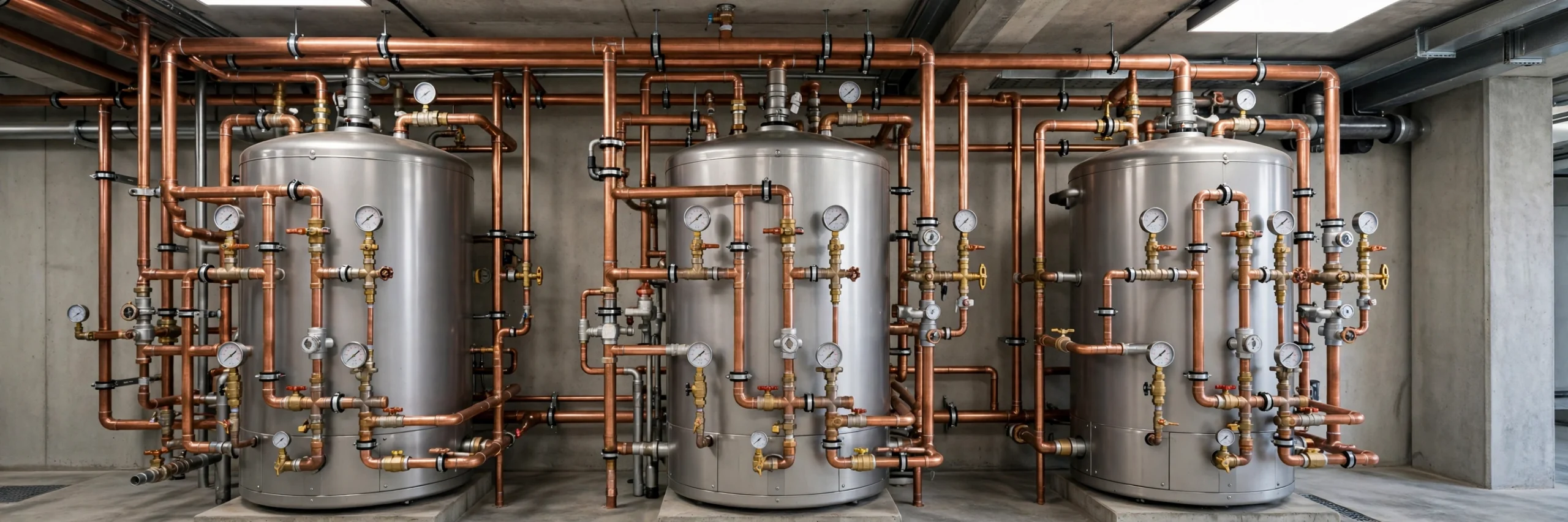
Commercial water heating systems are available in several configurations, each suited to different types of property and operational demand. Large-capacity storage tank systems are the most traditional commercial option and are well suited to properties with high but predictable demand that can be managed through accumulated stored volume. These systems typically use higher-BTU gas burners or larger-gauge electric elements than residential equivalents and are often configured in bank or cascade arrangements, where multiple tanks work in tandem to provide a combined capacity and redundancy that a single large tank cannot offer on its own. In Texas, where the hospitality and food service industry is among the largest in the country, large-capacity storage tank configurations remain a common choice for hotel laundry facilities, commercial kitchens, and multi-story residential properties.
High-output commercial tankless systems are an increasingly popular alternative for commercial applications where space is at a premium or where the demand pattern is variable rather than consistently high throughout the operational day. Commercial-grade tankless units designed for this purpose offer substantially higher flow rates than residential models and are built from more robust materials to withstand continuous high-load operation across extended service periods. Booster heaters are a third category of commercial water heating equipment designed specifically to raise water temperature at the point of final use, such as at a commercial dishwasher final rinse stage, where a temperature higher than the main system can safely deliver throughout the building is required for sanitization compliance. Our team assesses the operational demands, the building layout, and the applicable code requirements at each commercial property we work with to recommend the right system type or combination of system types for the specific context.
Sizing Commercial Water Heating for Consistent Peak Demand
The consequences of undersizing a commercial water heating system are considerably more serious than in a residential context. In a hotel, a breakfast rush that exhausts the stored hot water supply disrupts the experience of multiple guests simultaneously. In a commercial kitchen, a shortfall in hot water supply can halt food preparation workflows, delay service, and in a health code context, risk compliance with the minimum temperature requirements for handwashing and equipment sanitization that Texas regulatory bodies enforce for food service operations. Getting the sizing of a commercial system right is therefore not simply a comfort consideration but an operational and regulatory necessity that can directly affect a business’s ability to function and maintain its permits.
Commercial water heater sizing requires an analysis of peak simultaneous demand across all hot water draw points in the property, the expected usage profile throughout the operational day, the recovery rate required to replenish stored volume between demand peaks, and the characteristics of the incoming water supply including pressure, flow rate, and temperature. Texas’s rapid commercial development over the past two decades, particularly in cities such as Dallas, Austin, Houston, and San Antonio, has created a large and diverse stock of commercial properties with differing hot water demands, and a one-size approach to commercial system sizing is not appropriate across this breadth of property types. Our technicians carry out the detailed demand analysis that effective commercial system sizing requires, ensuring that the installed system can support the property’s full operational needs consistently and without shortfall.
Service and Maintenance Differences in Commercial Water Heating
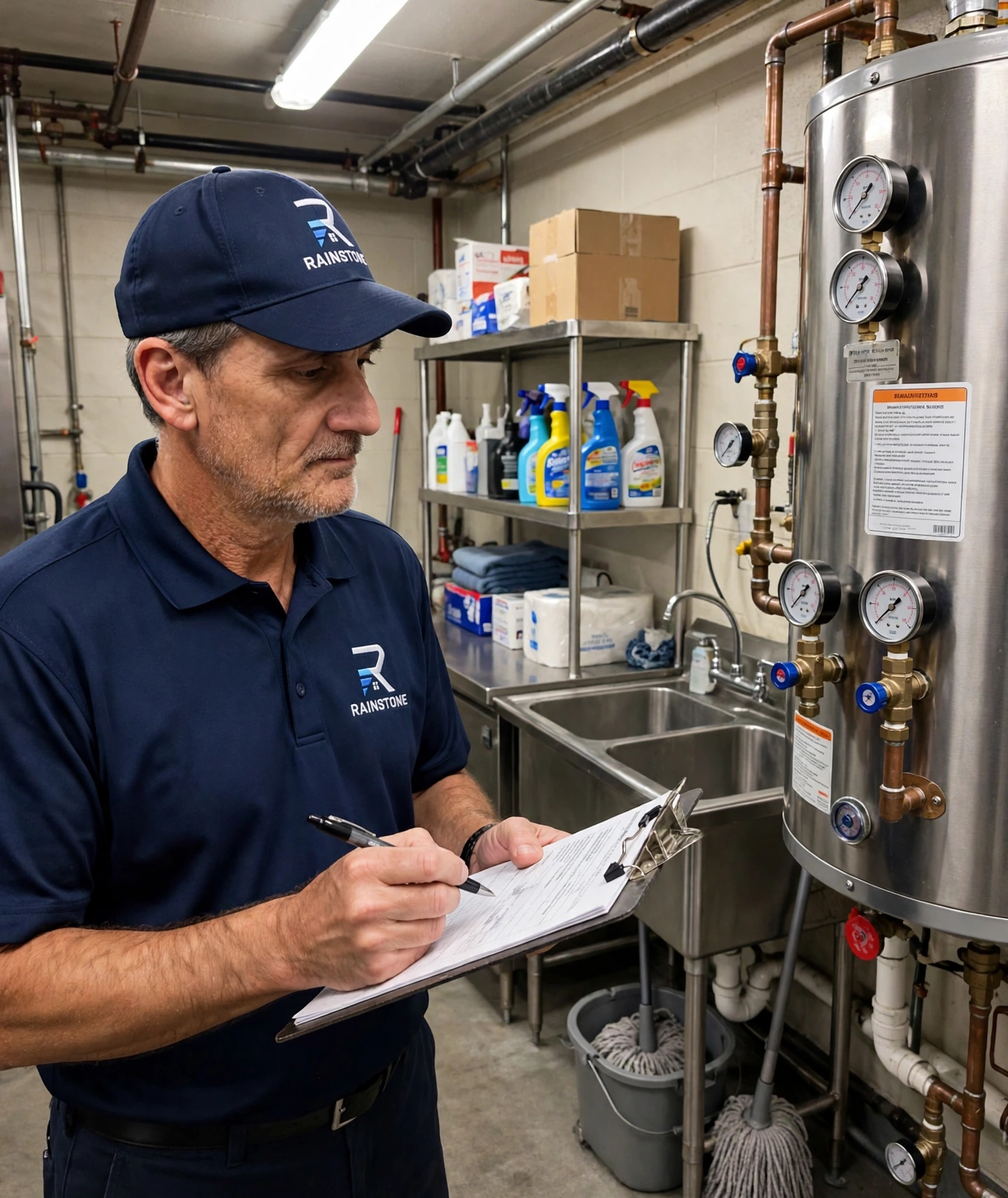
Commercial water heating systems typically require more frequent and more intensive maintenance than residential units due to the higher volume of water processed daily, the greater thermal cycling the equipment experiences, and the more stringent regulatory environment in which they operate. Scheduled descaling of heat exchangers, anode rod inspection and replacement in tank-based systems, TPR valve testing, flue and ventilation inspection, and thorough review of all connections and controls should be conducted on a schedule appropriate to the intensity of use rather than the calendar-based intervals that are generally sufficient for residential applications. In commercial kitchens and healthcare facilities, the maintenance schedule may also need to incorporate legionella risk management protocols, which require periodic temperature verification and system flushing to prevent the growth of legionella bacteria in stored water systems.
Our team works with commercial property managers and business owners across Texas to develop and deliver a maintenance schedule that is appropriate for their specific system type, usage intensity, and regulatory obligations. Planned preventive maintenance for commercial water heating systems reduces the risk of unexpected breakdowns during operational hours, extends the service life of the installed equipment, and supports compliance with the health and safety requirements that apply to commercial hot water supply in Texas. We document every maintenance visit thoroughly and provide property managers with records that can be produced in the event of a regulatory inspection or an insurance claim related to the water heating system.
Kurt’s take: I served as a master plumber for the Dallas Housing Authority, where hot water for hundreds of families ran on documentation and deadlines. Commercial work still gets that treatment from us: written findings, permitted work, no surprises. — Kurt Pinkerton, Responsible Master Plumber, Lic. # M-21546
Texas Compliance, Licensing, and Safety Standards for Commercial Water Heating
Hot Water Temperature Requirements Under Texas Health and Safety Regulations
Commercial properties in Texas that provide hot water for public or employee use are subject to minimum temperature requirements established by the Texas Department of State Health Services and enforced through the Texas Food Establishment Rules for food service operations and the Texas Plumbing Code for general commercial buildings. These regulations specify minimum delivery temperatures at specific point-of-use fixtures, with handwashing facilities in food service environments required to deliver water at a minimum temperature sufficient for effective sanitization, and commercial dishwashers required to achieve defined final rinse temperatures that vary by machine type and sanitization method. Compliance with these requirements is a condition of operating permits for many types of commercial property, and failure to maintain the required temperatures can result in violations during health inspections.
According to the Texas Department of State Health Services, food establishments across the state are subject to routine inspections that assess hot water availability and temperature compliance among other health and safety criteria. Our commercial service team is familiar with the temperature requirements that apply to different types of Texas commercial property and designs and services water heating systems with these specifications in mind, ensuring that our commercial clients can consistently meet regulatory standards during both normal operation and the high-demand periods that coincide with health inspection scheduling.
Backflow Prevention and Cross-Connection Control in Commercial Settings
Commercial water heating installations in Texas are subject to backflow prevention requirements that do not typically apply to straightforward residential installations. In a commercial setting, the risk of backflow — the reverse flow of water from the building’s plumbing system into the public supply — is managed through the installation and regular testing of approved backflow prevention assemblies at the point where the commercial supply connects to the water heater system. These assemblies are required in Texas for any commercial installation where there is a potential for contamination of the potable water supply, a category that includes virtually all commercial water heating applications given the elevated temperatures and chemical treatments that may be involved.
Backflow prevention assemblies installed on commercial water heating systems in Texas must be tested annually by a licensed backflow prevention assembly tester and the results submitted to the local water utility as evidence of ongoing compliance. Our commercial service team works with licensed backflow specialists to ensure that every commercial installation we carry out or service includes the appropriate backflow prevention measures and that our commercial clients remain in compliance with their annual testing obligations. This coordinated approach saves property managers from having to manage multiple contractors for what is fundamentally a single system’s compliance requirement.
Licensed Commercial Plumbing and Texas State Board Requirements
Commercial water heater installations and major servicing work in Texas must be carried out by a plumber licensed under the Texas State Board of Plumbing Examiners, which maintains separate licensing categories for residential and commercial plumbing work. The commercial plumbing license requires additional training and examination beyond the residential qualification, reflecting the greater complexity, regulatory scope, and public safety implications of commercial water system work. Engaging an unlicensed or residential-only licensed contractor to carry out commercial water heater installation or major repair work in Texas is a violation of state law and can expose the property owner to liability, permit complications, and insurance coverage issues if a fault develops in the system after the unlicensed work was carried out.
Rainstone Water Heaters operates with the appropriate licensing for the commercial work we carry out across Texas, and our technicians are qualified to work on commercial water heating systems of all scales within the scope of our services. We carry appropriate insurance coverage for commercial work, provide documentation of our licensing and qualifications on request, and approach every commercial project with the understanding that the stakes of getting it right extend beyond the immediate functionality of the water heater to the business’s compliance posture, operational reliability, and the safety of its staff and customers throughout the state.
Contact Rainstone Water Heaters for Commercial Water Heater Services in Texas Today
For commercial properties across Texas that depend on a reliable, compliant, and correctly maintained hot water supply, the team at Rainstone Water Heaters is ready to help. From system selection and installation to ongoing scheduled maintenance and emergency repair, we bring the know-how and commercial licensing required to service water heating systems in demanding operational environments throughout the state. Whether your property is a restaurant in central Dallas, a hotel on the Gulf Coast, a care facility in San Antonio, or a multi-unit building in any Texas city or community, our team understands what your system needs to perform reliably and compliantly. Call us today at (817) 580-8562 to book a service and discuss your commercial water heating requirements with our Texas team.
Local Commercial Water Heaters teams:
- Commercial Water Heaters in Garland
- Commercial Water Heaters in Round Rock
- Commercial Water Heaters in San Antonio
Commercial Water Heaters in Texas: the numbers we work by
| Residential | Commercial | |
|---|---|---|
| Demand pattern | Morning and evening peaks | Sustained, all-day draw — restaurants, gyms, salons, multi-unit buildings |
| Cost of failure | Discomfort | Downtime, compliance exposure, lost trade |
| Our answer | $125 service call, written quote | Same $125 service call and written quote — plus scheduling around your operating hours, 5 AM to 11 PM, seven days |
| Prevention | Annual flush and maintenance visit | Planned maintenance visits built around your peak calendar |
How we handle it, step by step
- We assess load, not just equipment. Your demand curve — covers, fixtures, laundry, dish machines — decides sizing and redundancy.
- We quote in writing and schedule around your hours, including early-morning work before your doors open.
- We install or repair to commercial code, with the permit and inspection handled.
- We set the maintenance rhythm — flushing and anode checks on a calendar matched to your usage, so failures stop being surprises.
I have trained more than 25 people from their first day holding a wrench all the way to Journeyman, and the first thing I teach every one of them is that a diagnosis you cannot explain to the homeowner is not a diagnosis at all.
My honest take for business owners: the cheapest commercial water heater strategy is a boring one — correctly sized equipment, maintained on schedule, with a plumber who already knows your building. Every emergency replacement I have ever done for a restaurant cost more than a decade of maintenance would have. Boring is profitable.
For an independent cross-check on the numbers above: the U.S. Department of Energy’s homeowner guidance puts a conventional storage water heater’s service life at roughly 10–15 years and recommends a thermostat setting of 120°F. The lifespan and price figures in our table are the ones Rainstone publishes in its own Texas cost guides — and the ones we stand behind on every written quote.
Ready when you are — call 817-580-8562 any day from 5 AM to 11 PM, and we will take it from there. — Kurt Pinkerton, Responsible Master Plumber, Lic. # M-21546