
Tankless water heaters have become an increasingly popular choice for Texas homeowners seeking to reduce energy costs, free up installation space, and move away from the limitations of a stored hot water supply. Unlike traditional tank units that maintain a full reservoir of heated water around the clock, tankless systems heat water only when it is needed, eliminating the standby energy losses that make conventional units less efficient over time. At Rainstone Water Heaters, we supply, install, and service tankless water heaters across Texas, helping homeowners find the right system for their property and household. Whether you are considering the switch for the first time or replacing an existing tankless unit, our team is ready to guide you through the options. Call us today at (817) 580-8562 to book a service and explore what a tankless system could do for your home.
Tankless is the right answer for a lot of Texas homes — and the wrong answer for some, which is exactly why the conversation matters more than the brochure. I am Kurt Pinkerton, Rainstone’s responsible master plumber. Across Texas, that means the same standard in every driveway: a $125 service call, a written quote, and work I am willing to sign my name to. Call us at 817-580-8562 and you will get exactly that.
How Tankless Water Heaters Work and Why They Suit Texas Homes
The On-Demand Heating Mechanism Explained
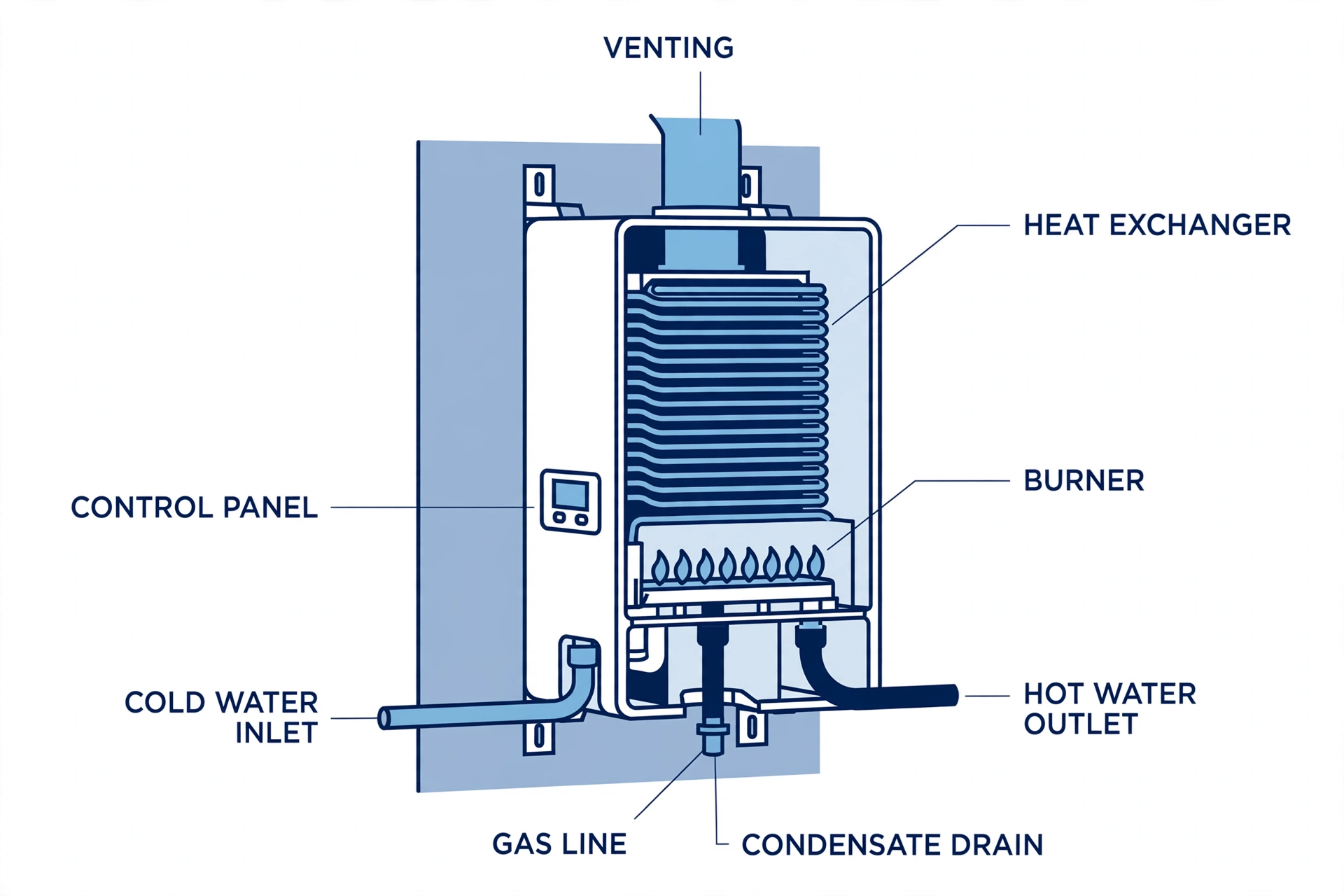
A tankless water heater operates by passing cold water through a heat exchanger that activates only when a hot water tap or appliance is opened. When demand is detected, the unit fires its gas burners or activates its electric heating elements to rapidly raise the water temperature to the set point before it exits the unit and travels through the household plumbing to the point of use. The moment the demand stops and the flow of water ceases, the heating system shuts down completely, consuming no energy until the next draw begins. This on-demand cycle is the defining operational difference between a tankless unit and a storage tank water heater, which must continuously maintain its stored volume at temperature whether or not any hot water is being used at any given moment.
The practical result of on-demand heating is a system that can theoretically deliver a continuous supply of hot water at the correct temperature for as long as there is demand, without the risk of running a stored supply dry as can happen with a conventional tank unit during periods of high simultaneous use. For Texas households with multiple bathrooms, a high occupancy, or a pattern of hot water usage that is spread across the day rather than concentrated in a single morning peak, this characteristic makes a tankless unit a genuinely practical improvement over a storage tank of fixed capacity.
How Tankless Units Handle High Hot Water Demand in Texas Homes
The flow rate capacity of a tankless water heater is measured in gallons per minute and determines how many simultaneous demands the unit can satisfy without a drop in output temperature. A unit with a rated flow of five gallons per minute can simultaneously supply a shower running at two gallons per minute and a dishwasher running at one and a half gallons per minute with capacity to spare, while a larger unit rated at ten or more gallons per minute can support significantly higher simultaneous loads without compromise. Selecting the correct flow rate capacity for a Texas household requires an accurate assessment of peak simultaneous demand, which our technicians carry out during every tankless installation consultation.
Texas’s warm climate is a meaningful advantage when it comes to tankless water heater performance. Because incoming groundwater temperatures in Texas are relatively mild for most of the year compared to colder-climate states in the Midwest or Northeast, tankless units operating in Texas achieve their rated flow capacity with less heating effort than the same unit installed in a colder location. The temperature rise required between the incoming water temperature and the desired output temperature is smaller in a Texas context, which means a unit of a given BTU or kilowatt rating can support a higher simultaneous flow rate in Texas than its published specification might suggest when calculated against cold-climate inlet temperatures.
Gas vs. Electric Tankless: Which Makes More Sense for Texas Properties
Texas’s natural gas infrastructure is among the most extensively developed in the country, and natural gas remains widely available as a household fuel across urban, suburban, and many rural communities throughout the state. Gas-powered tankless water heaters offer higher flow rate capacities than most residential electric models and heat water more rapidly, making them better suited to larger households or properties with high simultaneous demand. For Texas homeowners who are already on a natural gas supply, a gas tankless unit is generally the most capable option from a performance standpoint and avoids the need to upgrade the property’s electrical panel to support the significant amperage draw of a whole-home electric tankless unit.
Electric tankless units are a practical option in Texas properties where a natural gas connection is not available, such as certain rural areas, high-rise residential buildings, or properties where a gas line installation would be prohibitively expensive. Whole-home electric tankless units require a high-amperage dedicated circuit and may necessitate a panel upgrade in older homes that were not wired to support this level of draw. Point-of-use electric tankless units, which are small units installed at a single fixture such as a kitchen sink or bathroom, are a more accessible electric option and can be a cost-effective solution for reducing hot water wait times at a remote fixture without the full infrastructure requirements of a whole-home electric system.
Kurt’s take: Tankless rewards owners who keep a simple rhythm: descale on schedule and the unit runs for decades. I am a perfectionist about that calendar because the failures I see are almost never the machine — they are the missed years. — Kurt Pinkerton, Responsible Master Plumber, Lic. # M-21546
Energy Savings, Lifespan, and Financial Benefits for Texas Property Owners
Eliminating Standby Heat Loss and Its Impact on Energy Bills
The energy efficiency advantage of a tankless water heater over a conventional storage tank unit stems primarily from the elimination of standby heat loss, which is the energy consumed by a storage tank unit to maintain its stored water volume at temperature throughout the day and night, regardless of whether any hot water is being used. According to the U.S. Department of Energy, tankless water heaters can be 24 to 34 percent more energy efficient than conventional storage tank water heaters for households that use a moderate volume of hot water daily. In homes with higher hot water usage, whole-home tankless units can still achieve efficiency gains of eight to fourteen percent over a conventional tank, representing a meaningful and ongoing reduction in energy expenditure across the life of the unit.
For Texas homeowners in rapidly growing suburban communities across the DFW Metroplex, Greater Houston, and the Austin-San Antonio corridor, where utility costs are a consistent household budget concern, the cumulative energy savings from a tankless unit can represent a significant financial benefit over the ten to twenty years of the unit’s operating life. These savings are most pronounced in households that previously operated an older, low-efficiency tank unit, where both the standby loss elimination and the improvement in active heating efficiency contribute to a noticeable reduction in the water heating component of monthly energy bills.
Extended Service Life and Reduced Long-Term Maintenance Costs
One of the frequently cited advantages of tankless water heaters is their longer expected service life compared to conventional storage tank units. Where a well-maintained storage tank unit might last ten to twelve years, a properly serviced tankless unit is generally expected to remain in reliable service for fifteen to twenty years or more. This extended lifespan is possible in part because tankless units do not hold standing water continuously, reducing the internal corrosion risk that accumulates in storage tank units over time. In Texas, where hard water conditions can shorten the service life of storage tank units, the different internal design of a tankless unit offers some resistance to the most aggressive effects of mineral-laden water, particularly when combined with an appropriate water treatment or pre-filtration solution.
Maintenance requirements for tankless units in Texas typically include an annual descaling service to remove mineral buildup from the heat exchanger, inlet filter cleaning, and periodic inspection of the gas connections and venting system. While the unit type and maintenance procedures differ from those of a storage tank unit, the annual maintenance investment is comparable in cost and produces similar benefits in terms of sustained efficiency and extended service life. Our team services tankless units across Texas with the same care and attention to detail that we bring to every type of water heating equipment we work with.
Tax Credits and Incentives Available to Texas Homeowners
Texas homeowners who install qualifying tankless water heaters may be eligible for federal tax credits under the Inflation Reduction Act, which provides incentives for residential energy efficiency improvements including the installation of ENERGY STAR certified water heating equipment. Qualifying gas condensing tankless water heaters and certain electric models with a high Uniform Energy Factor rating are eligible for a tax credit of up to six hundred dollars, which directly reduces the net installation cost for the homeowner. This incentive is available for units installed in an existing primary residence and is claimed through the homeowner’s federal tax return for the year in which the equipment was placed in service.
In addition to federal credits, some Texas utility providers and local energy efficiency programs offer rebates for customers who replace older tank-style water heaters with qualifying tankless models, particularly in cases where the replacement reduces peak demand on the electricity grid. Our team stays current on available incentives across the Texas markets we serve and advises homeowners on which programs may apply to their specific installation at the time of their service booking. Factoring available credits and rebates into the total cost assessment of a tankless installation can meaningfully shift the financial comparison between a tankless unit and a conventional replacement, making the more efficient choice the more financially accessible one at the same time.
Upgrade to a Tankless Water Heater in Texas With Rainstone Water Heaters Today
Switching to a tankless water heater is one of the most impactful upgrades a Texas homeowner can make to their home’s water heating system, delivering immediate efficiency gains, a continuous hot water supply, and a longer-lasting unit that requires less maintenance over its service life. At Rainstone Water Heaters, we have the know-how to help you select the right tankless system for your home and household, carry out the installation to the highest standard, and keep the unit performing efficiently through regular professional servicing. Whether you are in a major Texas metropolitan area or a smaller community elsewhere in the state, we are ready to help you make the most of what tankless technology has to offer. Call us today at (817) 580-8562 to book a service and take the next step.
Tank vs. tankless: the numbers we give Texas homeowners
I’m Kurt Pinkerton, Rainstone’s responsible master plumber. When a homeowner asks me whether tankless is worth it, this is the comparison I walk them through:
| Standard tank | Tankless | |
|---|---|---|
| Typical lifespan in Texas | 8–12 years | 15–20 years |
| Typical replacement range | $1,850–$2,800 | $4,800–$6,000 |
| Replacement tiers | Good $1,850 · Better $2,450 (upgraded tank + expansion tank) | Best from $4,800 |
My honest take: if your tank is healthy and your household is small, a tank flushed every year is the economical choice. If you keep running out of hot water — or your tank is past the ten-year mark — tankless usually wins on lifespan alone. Either way, we quote the work before we start it.
Local Tankless Water Heaters teams:
- Tankless Water Heaters in Garland
- Tankless Water Heaters in Round Rock
- Tankless Water Heaters in San Antonio
Tankless Water Heaters in Texas: the numbers we work by
| Tankless fact | The number |
|---|---|
| Typical lifespan | 15–20 years — roughly double a standard tank’s 8–12 |
| Typical installed range | $4,800–$6,000 |
| Best configuration | From $4,800 |
| Non-negotiable upkeep | Annual descaling — Texas water is hard, and scale is what kills these units early |
How we handle it, step by step
- We size by flow, not by hope. Simultaneous showers, tubs, and appliances set the gallons-per-minute the unit must deliver.
- We check the gas line and venting honestly. If your home cannot feed a tankless unit without major work, the quote shows that work — or we recommend a tank.
- We install and commission — temperature set, flow tested at the fixtures, error codes clear.
- We descale it every year, which is what turns a 15-year promise into a 20-year unit.
I have trained more than 25 people from their first day holding a wrench all the way to Journeyman, and the first thing I teach every one of them is that a diagnosis you cannot explain to the homeowner is not a diagnosis at all.
My honest take: a tankless unit that never gets descaled in Texas water is an expensive way to buy a 7-year water heater. The technology is genuinely better — endless hot water, double the lifespan — but only for homeowners who keep the one appointment a year it asks for. If that is not you, a good tank, honestly installed, will make you happier.
Ready when you are — call 817-580-8562 any day from 5 AM to 11 PM, and we will take it from there. — Kurt Pinkerton, Responsible Master Plumber, Lic. # M-21546