
Installing a water heater correctly is about more than connecting pipes and turning on the supply. A professional installation ensures that the unit is positioned correctly, connected to the right services, tested thoroughly, and compliant with applicable Texas plumbing codes and permit requirements. At Rainstone Water Heaters, we carry out water heater installations across Texas for new builds, home renovations, and replacement projects alike, bringing the same standard of careful, code-compliant workmanship to every job. Whether you are adding a water heater to a newly constructed home in a growing Texas suburb or fitting a replacement in an established residential property, our team handles every stage of the process from site preparation through to final testing. Call us today at (817) 580-8562 to book a service and get your installation scheduled.
An installation done right disappears from your life for a decade or more. An installation done cheaply comes back as leaks, code violations, and a warranty argument. I am Kurt Pinkerton, Rainstone’s responsible master plumber, and installation quality is where I am least willing to compromise. Across Texas, that means the same standard in every driveway: a $125 service call, a written quote, and work I am willing to sign my name to. Call us at 817-580-8562 and you will get exactly that.
What Happens During a Professional Water Heater Installation in Texas
Site Assessment and Installation Space Preparation
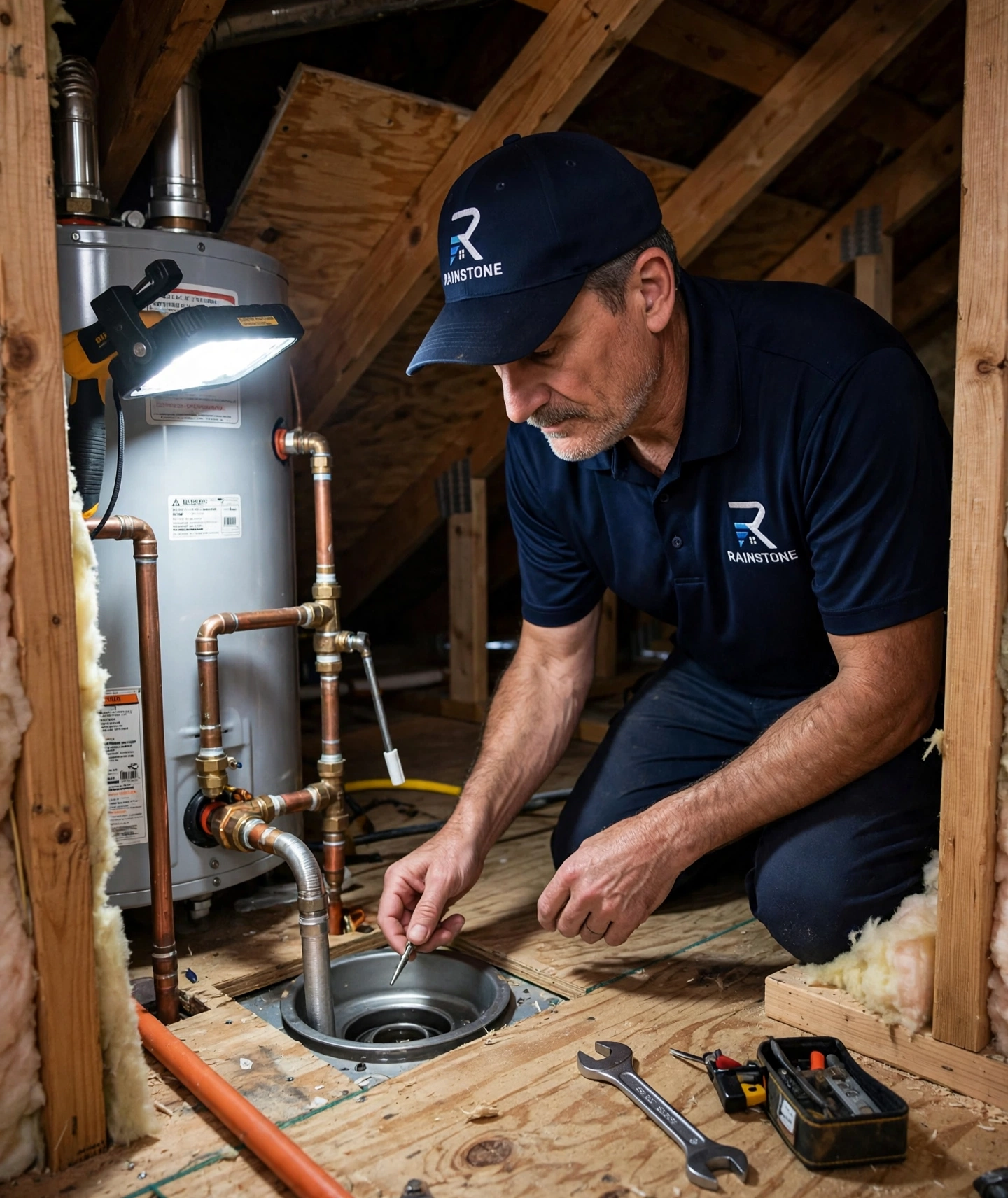
Every professional water heater installation begins with a thorough assessment of the installation site before any work is carried out or equipment is moved into position. Our technicians check that the designated space meets the minimum clearance requirements for the unit being installed, including adequate distance from combustible materials for gas units and sufficient ventilation for any unit type that requires it. They also assess the condition of the existing plumbing connections, the structural surface on which the unit will rest or be mounted, and the proximity of the drain connection, which is necessary for the pressure relief valve discharge pipe. Identifying any issues with the installation environment at this stage avoids complications partway through the job and ensures that the completed installation meets both manufacturer requirements and applicable code standards.
In Texas, where a significant number of water heaters are installed in garages, outdoor alcoves, or unconditioned utility spaces, the assessment phase also includes evaluating the thermal environment the unit will operate in throughout the year. Units installed in unconditioned garages in Texas can be exposed to ambient temperatures that reach well above ninety degrees Fahrenheit in summer and, in North Texas, drop to near freezing on occasional winter nights. Understanding this operating environment is important for advising on unit type, insulation requirements, and in the case of heat pump water heaters, whether the surrounding air volume is sufficient to support the heat exchange process efficiently across all seasons.
Plumbing Connection, Expansion Tank Fitting, and Pressure Testing
With the site confirmed and the unit positioned, our technicians connect the cold water supply and hot water outlet pipes to the unit using appropriate fittings and connection methods for the pipe material present in the property. Where the existing plumbing uses older materials or where corrosion is present at connection points, our team addresses these issues at the time of installation rather than connecting new equipment to compromised pipework that is likely to cause problems in the short term. Dielectric unions are used wherever copper pipes meet the steel tank fittings, preventing galvanic corrosion at the connection point, which is a particularly important detail in Texas properties where aggressive hard water accelerates corrosion at dissimilar metal joints.
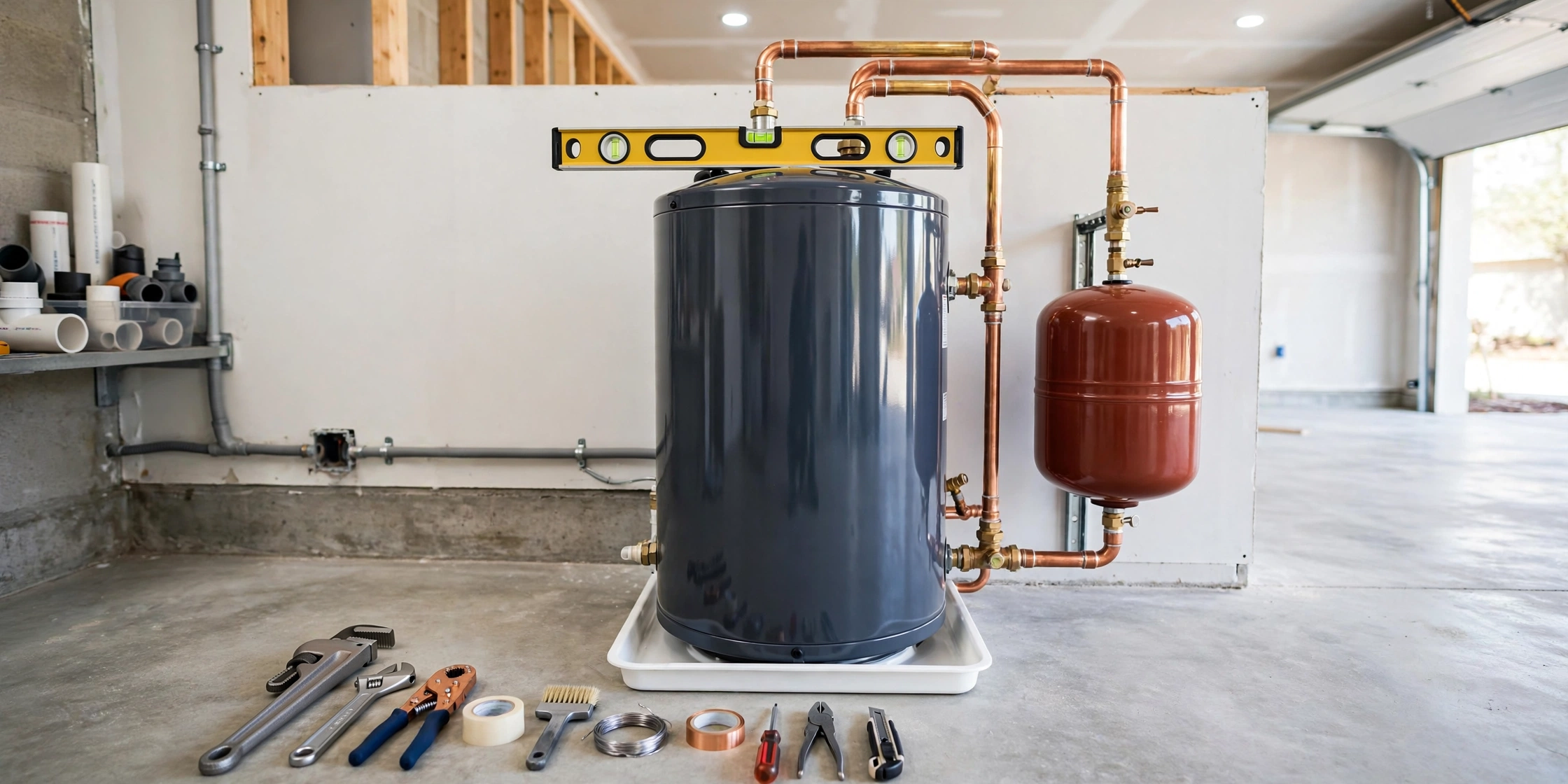
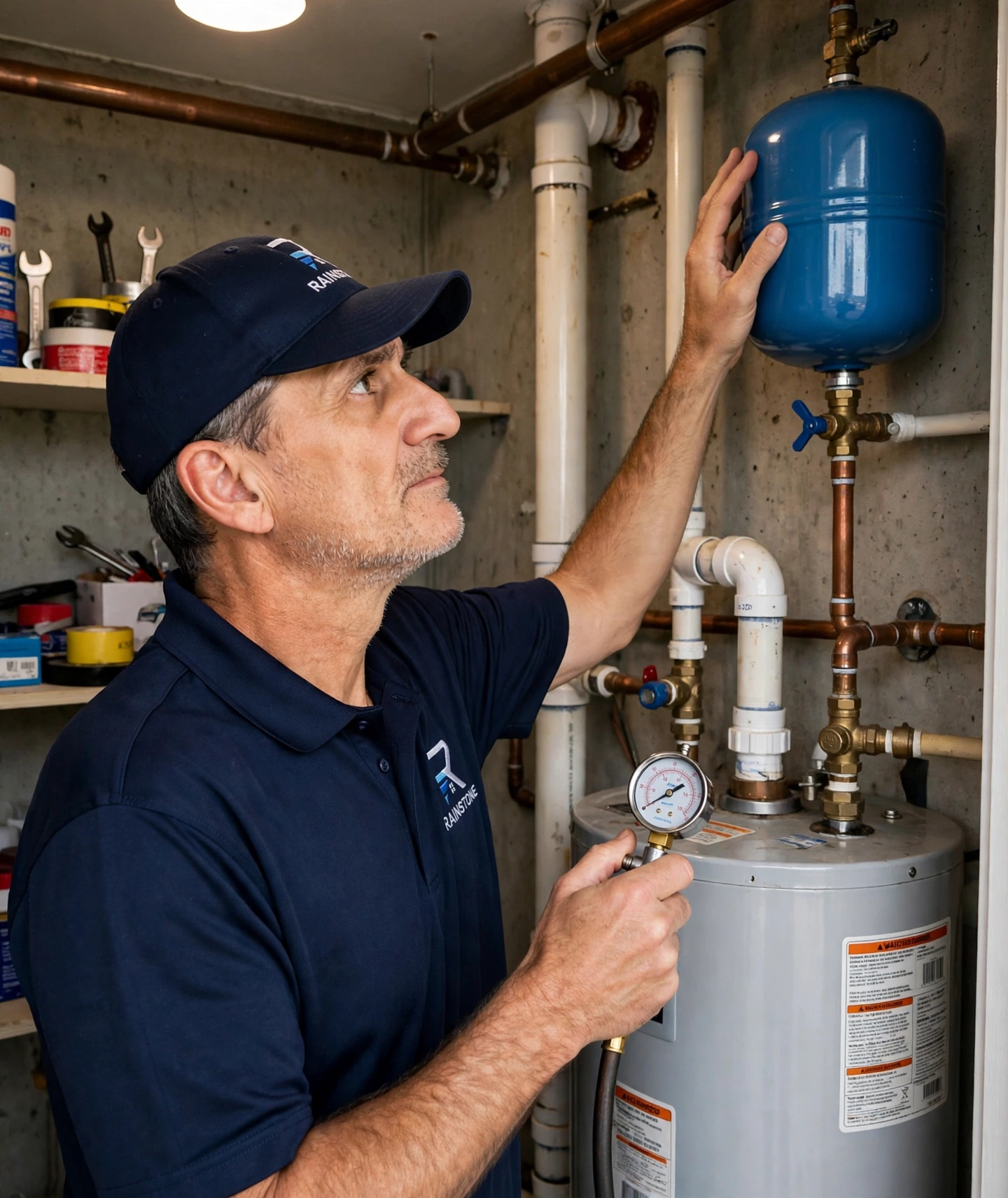
In closed plumbing systems — which are now required in many Texas municipalities — an expansion tank is also installed alongside the water heater to accommodate the thermal expansion of water as it is heated. Without an expansion tank in a closed system, the increased pressure generated by heating has nowhere to dissipate and can cause repeated triggering of the pressure relief valve, damaging the valve over time and potentially stressing other plumbing components throughout the property. Our technicians confirm whether an expansion tank is required based on the local water supply configuration and install one as a standard component of the job wherever the system demands it.
Gas or Electrical Connections and Safety Verification
For gas water heaters, the gas supply line connection is one of the most safety-critical stages of the entire installation. Our technicians connect the gas line using the correct flexible connector rated for the unit’s BTU demand, confirm that all joints are sealed, and test the connection for leaks before the gas supply is turned on for the first time. The burner is then lit and allowed to run through its first heating cycle while the technician monitors ignition, flame characteristics, and the correct operation of the gas valve and thermostat. Any abnormality detected during this initial run is investigated and resolved before the installation is considered complete.
For electric water heaters, the electrical connection must be made to a dedicated circuit of the correct amperage rating for the unit, with appropriately sized wiring and a breaker that matches the unit’s draw specifications. Our technicians verify that the existing electrical supply at the installation point meets the unit’s requirements before connecting, and where the available circuit is undersized, this is identified and communicated to the homeowner before the installation proceeds. A correct electrical connection not only ensures safe operation but also ensures that the unit’s warranty remains valid, as many manufacturers void warranty coverage on units connected to improperly rated electrical supplies.
Final Testing, Thermostat Setting, and Homeowner Walkthrough
Before our technicians leave any installation, the newly installed water heater is tested fully to confirm correct operation across all functions. This includes checking all plumbing connections for leaks at full working pressure, verifying that the pressure relief valve is seated and discharges correctly when tested, confirming that the unit reaches and holds the target temperature, and for gas units, confirming clean combustion and proper venting through the flue. The thermostat is set to the recommended default temperature of one hundred and twenty degrees Fahrenheit, which is the setting endorsed by public health authorities as balancing effective hot water provision with the reduction of scalding risk and the inhibition of legionella bacteria growth.
Following the functional test, our technicians walk the homeowner through the key aspects of operating and maintaining their new water heater, including the location of the shut-off valve, how to adjust the thermostat safely, what the pressure relief valve is and how to identify if it has activated, and when the unit’s first maintenance service should be scheduled. This walkthrough is an important part of our installation service because a water heater that is properly understood and maintained from the start will consistently outlast one that is left to run unattended until a problem develops.
Kurt’s take: I own the permits and the inspections on every installation we run — that is what a responsible master plumber’s license means in practice. An install that cannot pass inspection was never finished, whatever the invoice says. — Kurt Pinkerton, Responsible Master Plumber, Lic. # M-21546
Permits, Code Compliance, and Licensing Standards in Texas
When a Permit Is Required for a New Water Heater in Texas
In most Texas jurisdictions, a permit is required before a new water heater is installed, whether the installation involves a new unit or a direct replacement of an existing one. Permit requirements exist to ensure that installed water heaters are inspected by the relevant authority, verified to meet code, and recorded as part of the property’s documented improvement history. Homeowners who bypass the permit process and have a water heater installed without the required approvals may encounter complications when selling the property, making an insurance claim for water damage related to the unit, or seeking warranty service from the manufacturer. The permit requirement applies regardless of whether the work is carried out by a professional or by the homeowner themselves, though many Texas jurisdictions restrict water heater installation to licensed plumbers only.
The Texas State Board of Plumbing Examiners licenses and regulates plumbers across the state, and work carried out by an unlicensed individual on a water heater connected to the gas or water supply systems of a Texas property is a violation of state law in most circumstances. Our technicians are appropriately licensed and familiar with the permit processes across the Texas jurisdictions we serve, handling the application and inspection coordination on behalf of the homeowner as part of the installation service wherever required. This removes the administrative burden from the homeowner and ensures that the completed installation is fully documented and code-compliant from the outset.
Texas Plumbing Code Standards That Apply to Every Installation
Texas water heater installations are governed by the Texas Plumbing Code, which is the state’s adopted version of the International Plumbing Code with Texas-specific amendments incorporated by the Texas State Board of Plumbing Examiners. The code establishes requirements covering unit placement, clearance distances, venting configuration, the installation of pressure relief valve discharge pipes, seismic and wind resistance requirements in applicable regions, and the materials permitted for plumbing connections. Compliance with these standards is not optional, and an installation that does not meet code can require costly remediation if identified during a subsequent inspection or property sale.
Specific requirements of note in Texas include the mandatory installation of seismic strapping on water heaters in earthquake-prone regions, the requirement that pressure relief valve discharge pipes terminate at a safe location where hot water will not create a scalding hazard, and minimum clearance standards that vary depending on the fuel type of the unit being installed. Our team applies current code requirements to every installation we carry out, ensuring that the completed job is not only functional but fully compliant with the standards in force in the specific Texas jurisdiction where the work is performed.
Book Your Water Heater Installation in Texas With Rainstone Water Heaters Today
A water heater installation that is done correctly from the outset saves you from the cost and disruption of remedial work, permit issues, or premature component failures caused by improper connections or code violations. At Rainstone Water Heaters, we bring thorough, code-compliant installation experience to every project we undertake across Texas, from first-time installs in new construction to full replacements in established homes across the state. Whether your property is in North Texas, Central Texas, or the Gulf Coast region, our licensed technicians handle every stage of the job with the care and precision that a properly functioning hot water system requires. Call us today at (817) 580-8562 to book a service and get your installation underway.
Water Heater Installation in Texas: the numbers we work by
| Installation | Typical installed range | What the work includes |
|---|---|---|
| Standard tank (Good $1,850 · Better $2,450) | $1,850–$2,800 | Unit, code-compliant hookup, permit handling, old-unit haul-away |
| Tankless (Best from $4,800) | $4,800–$6,000 | Unit, venting and gas-line work the model requires, permit handling, startup and walkthrough |
| Every job starts with | $125 service call | On-site assessment and a written quote before any installation is booked |
How we handle it, step by step
- We assess the site first. Location, venting path, gas or electric capacity, and drainage decide what can be installed safely — before anything is ordered.
- You approve a written quote. The range above is honest for typical jobs; your quote is exact for yours.
- We install to current code — drain pan, expansion tank where required, correct venting, and a T&P valve discharging somewhere safe.
- We commission and teach. The unit is fired, tested at the taps, and you are shown the shut-offs and settings before we leave.
I have spent 38 years in this trade, 27 of them as a master plumber, and the pattern has never changed: the expensive failures almost always start as cheap ones somebody ignored.
My honest take: the lowest installation bid is usually low because something was left out — the permit, the expansion tank, the pan, the venting upgrade. Those are not extras; they are the difference between an installation and a liability. Ask any installer what their price leaves out, and watch how the conversation changes.
For an independent cross-check on the numbers above: the U.S. Department of Energy’s homeowner guidance puts a conventional storage water heater’s service life at roughly 10–15 years and recommends a thermostat setting of 120°F. The lifespan and price figures in our table are the ones Rainstone publishes in its own Texas cost guides — and the ones we stand behind on every written quote.
Ready when you are — call 817-580-8562 any day from 5 AM to 11 PM, and we will take it from there. — Kurt Pinkerton, Responsible Master Plumber, Lic. # M-21546
Find Water Heater Installation in your city: